Topic cluster
Artificial intelligence and marketing
10 posts
Artificial intelligence (AI) has become an everyday marketing tool, used for everything from drafting copy to analysing campaign results. But the tool itself does not create a strategy. AI saves time and generates more options; deciding what is right remains a human responsibility. In this section, we approach AI as a step in the workflow, rather than a form of magic.
Where does AI deliver real value in marketing?
In practice, the benefits are clear in four areas:
- Content creation. Headline variations, first drafts, shortening long texts and translation. AI's strength lies in helping you get past the blank page.
- Analytics. Finding patterns in large spreadsheets, explaining reports in plain language and spotting anomalies.
- Advertising. Generating more creative variations and testing copy; advertising platforms' own automation tools also use AI.
- Customer communication. Answering frequently asked questions, categorising messages and handling initial screening.
A practical approach to writing prompts
The quality of the output depends almost entirely on the quality of the prompt. An effective prompt has four elements: role (who the AI should respond as), context (who it is for and under what circumstances), task (exactly what you want) and format (the required length and structure). A fifth element is also useful: an example. One good example produces a more precise result than ten sentences of explanation.
The second rule is to avoid asking for everything in a single prompt. For longer content, you will get better results by requesting an outline first, then drafting section by section, and finally asking for an edit.
Why is publishing unedited AI copy risky?
There are three reasons. The first is accuracy: a model can produce convincing but incorrect information, particularly about figures, dates, legislation and local market details. The second is experience: AI knows nothing about your actual projects, yet specific experience is what makes content persuasive. The third is tone of voice: AI drafts often sound noticeably alike and fail to reflect your brand's distinctive voice.
An effective approach is to use AI to speed up outlining and drafting, check the facts yourself, add your own experience and examples, and have a person make the final edit. Used this way, AI helps the writer work faster.
Data security
Uploading client data, contract terms or unannounced campaign plans to public AI services means sharing that information with a third party. Follow a simple rule: only give an external tool information that could be made public. If personal data (names, phone numbers or email addresses) is involved, anonymise it first.
AI and search: what is changing?
AI-generated answers are now a familiar feature of search results. The practical consequence is that superficial content repeating what everyone else says attracts fewer clicks, because the search engine already provides that answer. What stands out is what AI cannot supply on its own: real figures, your own experience, specific examples and original analysis. Content strategy in the AI era is therefore shifting from "write more" to "write what only you can contribute".
How do you introduce AI to your team?
One of the least successful ways to introduce AI to a team is to tell everyone to use it. Before long, people are using different tools, output quality varies and nobody knows what is working. A more sustainable approach has three steps: create shared prompt templates for a few recurring tasks, document where outputs need to be checked, and clearly define which information must never be shared with external tools.
Templates deliver the greatest benefit: instead of rewriting the same prompt every time, the team simply adds context to an existing structure. This saves time and produces more consistent results.
What should you measure?
The value of AI should be measured by more than a feeling that things are going well. Useful metrics include the time needed to produce each piece of content, the number of pieces produced per month, time spent editing and output quality (how many revisions are needed before publication). Comparing these figures before and after introducing AI reveals its real value. Sometimes the benefit is smaller than expected; sometimes it is greater in unexpected areas.
Choosing tools
The number of tools is growing rapidly, and keeping track of them all is impossible. Three questions are enough to guide your choice: which recurring task will this tool handle, can I verify its output, and where will my data be stored? If you cannot answer these three questions, the tool should not become part of your workflow, however popular it may be.
When should you avoid using AI?
For some tasks, AI brings more risk than benefit. In legal and financial copy, medical claims and formal submissions, a single incorrect sentence can have serious consequences. Automating sensitive customer communication, such as complaint responses or apology letters, can also make it feel cold and formulaic, making the problem worse.
The guiding principle is simple: the higher the cost of an error, the greater the need for human oversight. AI can work with more autonomy on repetitive tasks where the risk is low; for tasks where the risk is high, its involvement should be limited to drafting.
Where to start
The simplest way to start is to record your tasks for a week and choose three that are repetitive and can be standardised. Test AI on just those three tasks first, then compare its output with your manual work. Expand its use once you have measured the benefits. The articles below explore specific use cases for content, analytics and advertising.
Posts in this topic
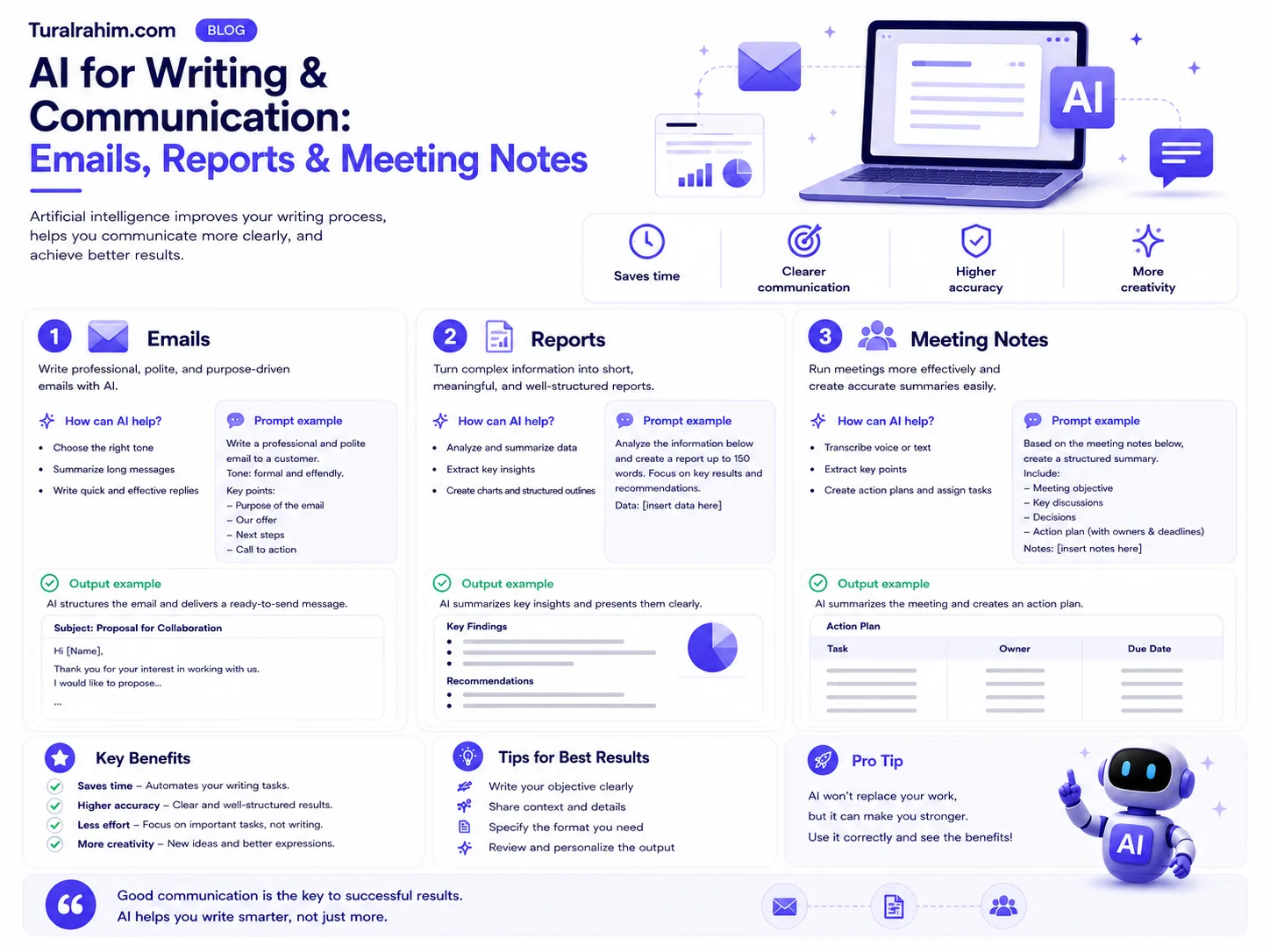
17 İyul 2026·⏱ ≈11 min
Writing and Communicating with AI: Emails, Reports and Meeting Notes
Business communication with AI: turning meeting notes into an action plan, adapting the same news for different recipients, getting feedback on your writing and rehearsing difficult conversations.
Read →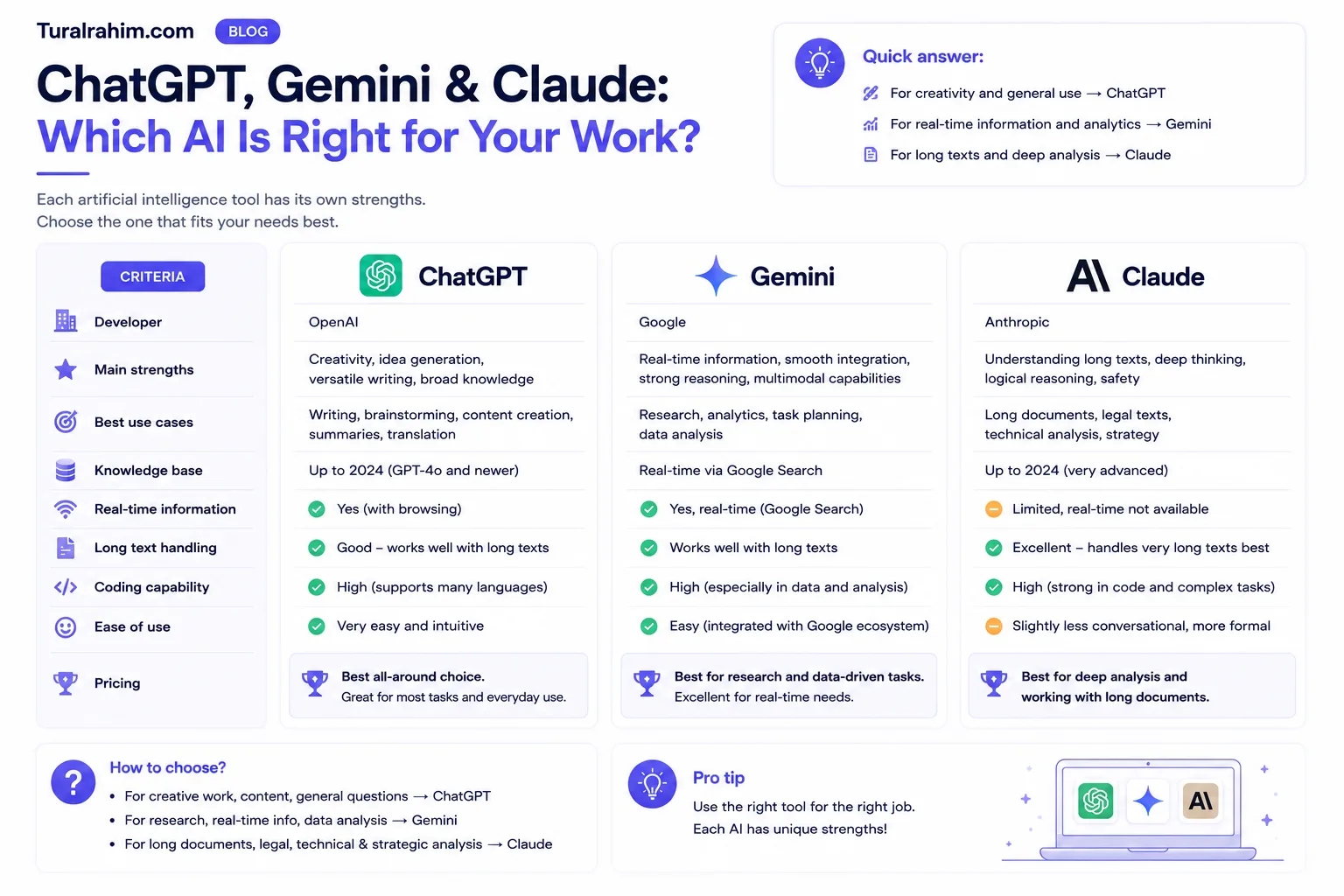
17 İyul 2026·⏱ ≈11 min
ChatGPT, Gemini and Claude: which AI is right for your work?
ChatGPT, Gemini and Claude compared: strengths and weaknesses, 2026 pricing, how well they work in Azerbaijani and which to choose for each task.
Read →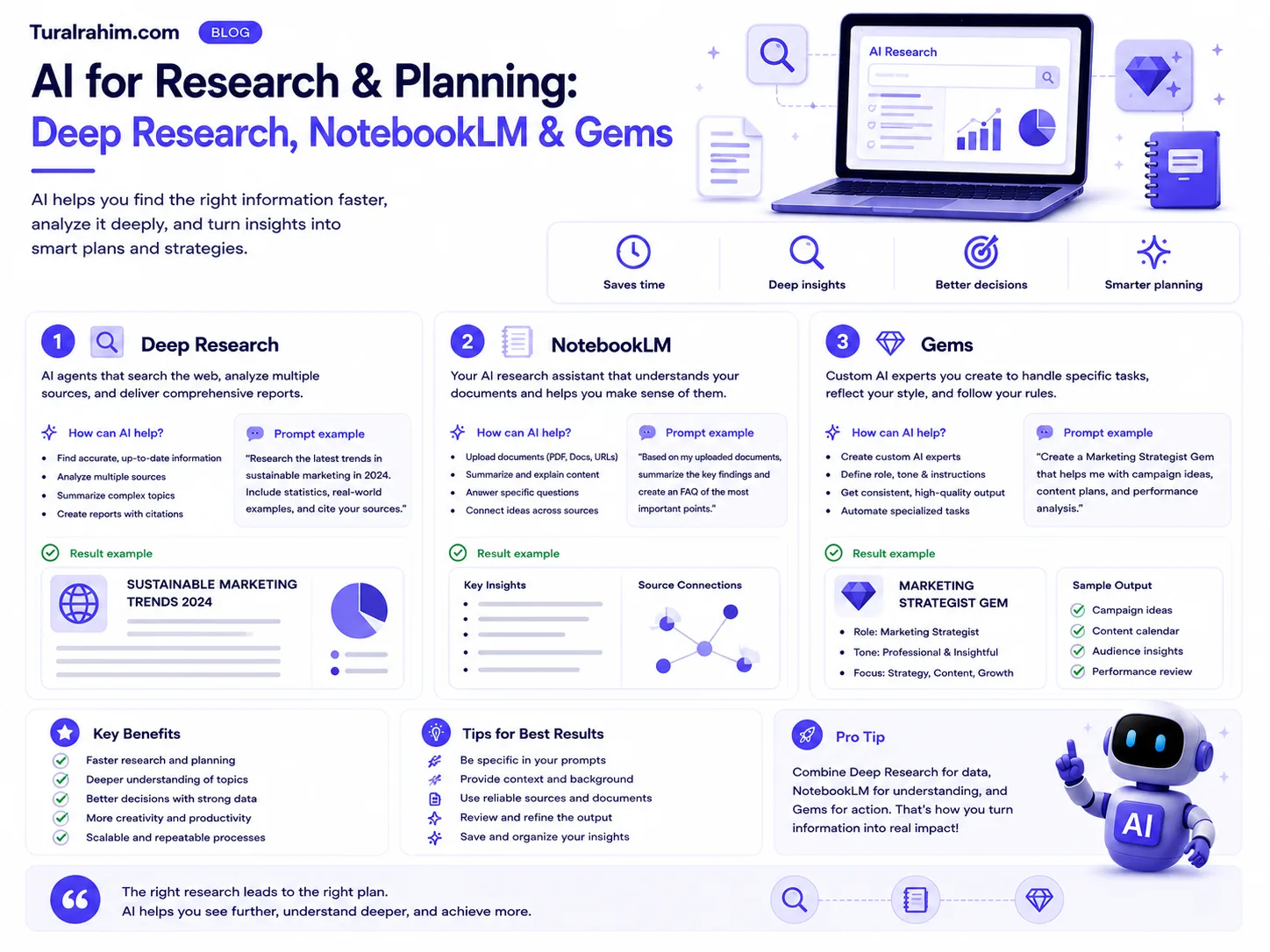
17 İyul 2026·⏱ ≈11 min
Research and Planning with AI: Deep Research, NotebookLM and Gems
Using AI for in-depth research, a knowledge hub (NotebookLM), expert assistants (Gems), risk analysis and project planning: supporting strategic decisions.
Read →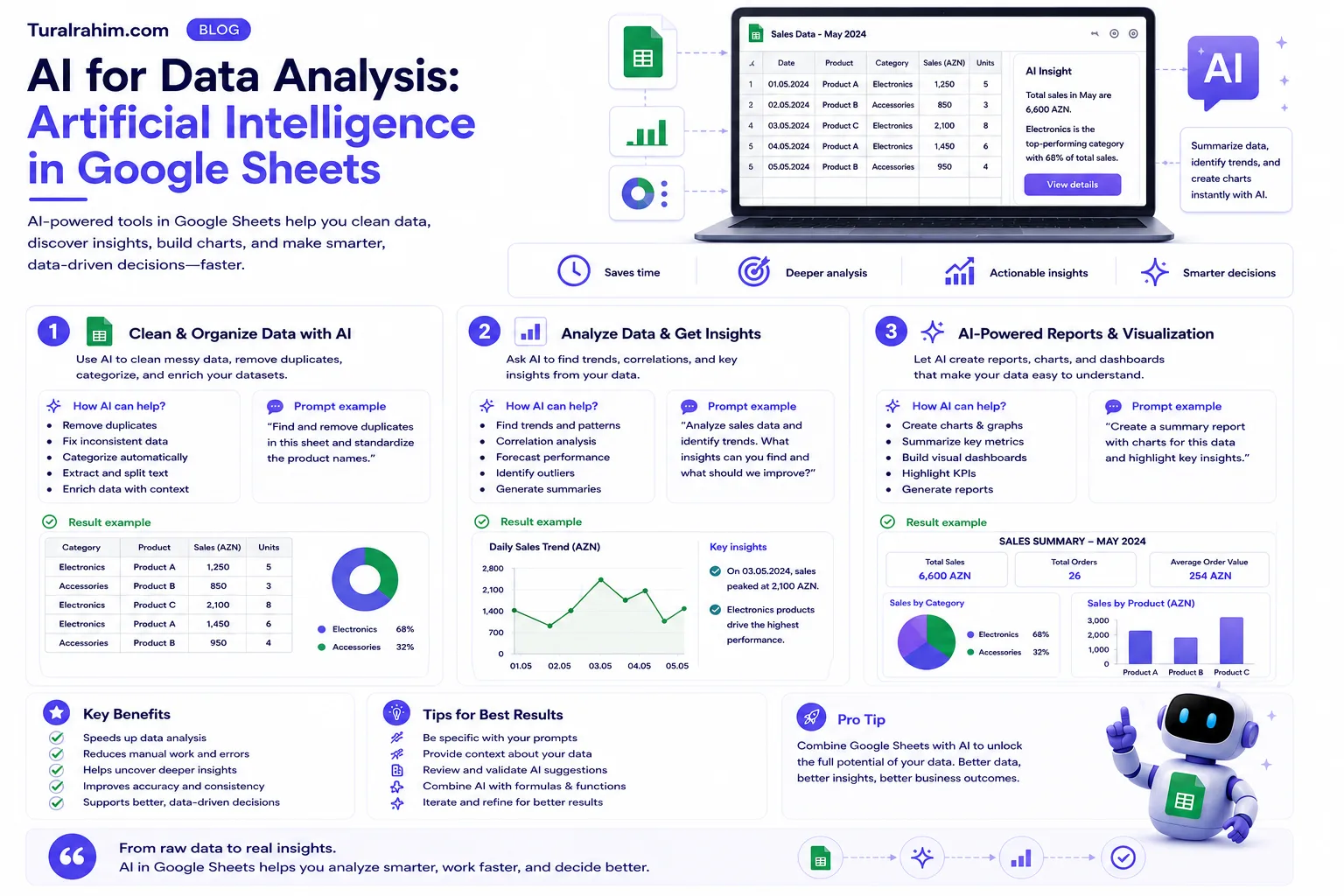
17 İyul 2026·⏱ ≈11 min
Data Analysis with AI in Google Sheets
Data analysis with AI: cleaning data, asking questions in plain language, using the =AI() function in Sheets, creating charts and checking results: without knowing Excel.
Read →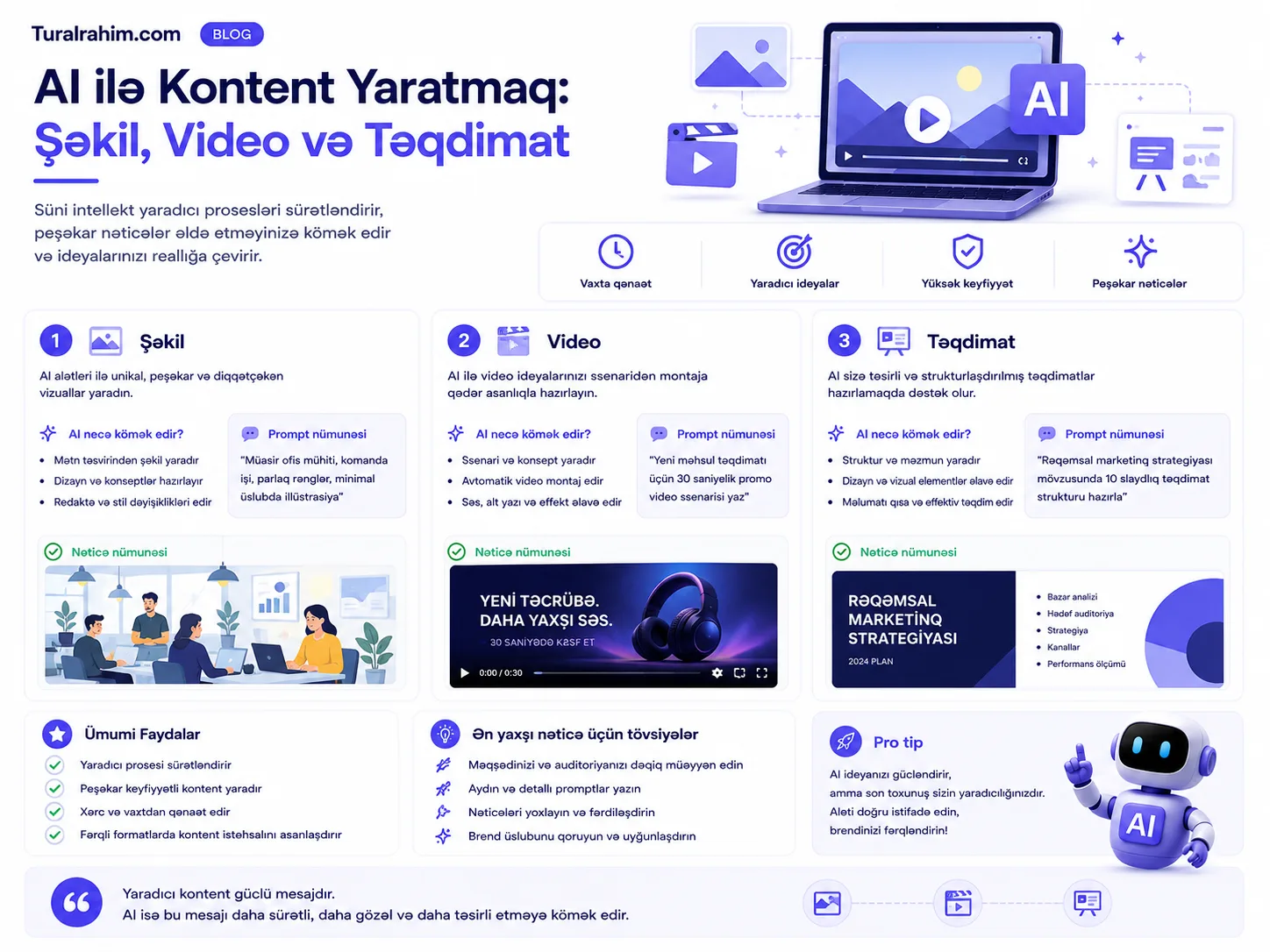
17 İyul 2026·⏱ ≈11 min
Creating Content with AI: Images, Videos and Presentations
Creating images, videos and presentations with AI: multimodal workflows, writing effective image prompts, editing existing images and knowing when AI is unsuitable.
Read →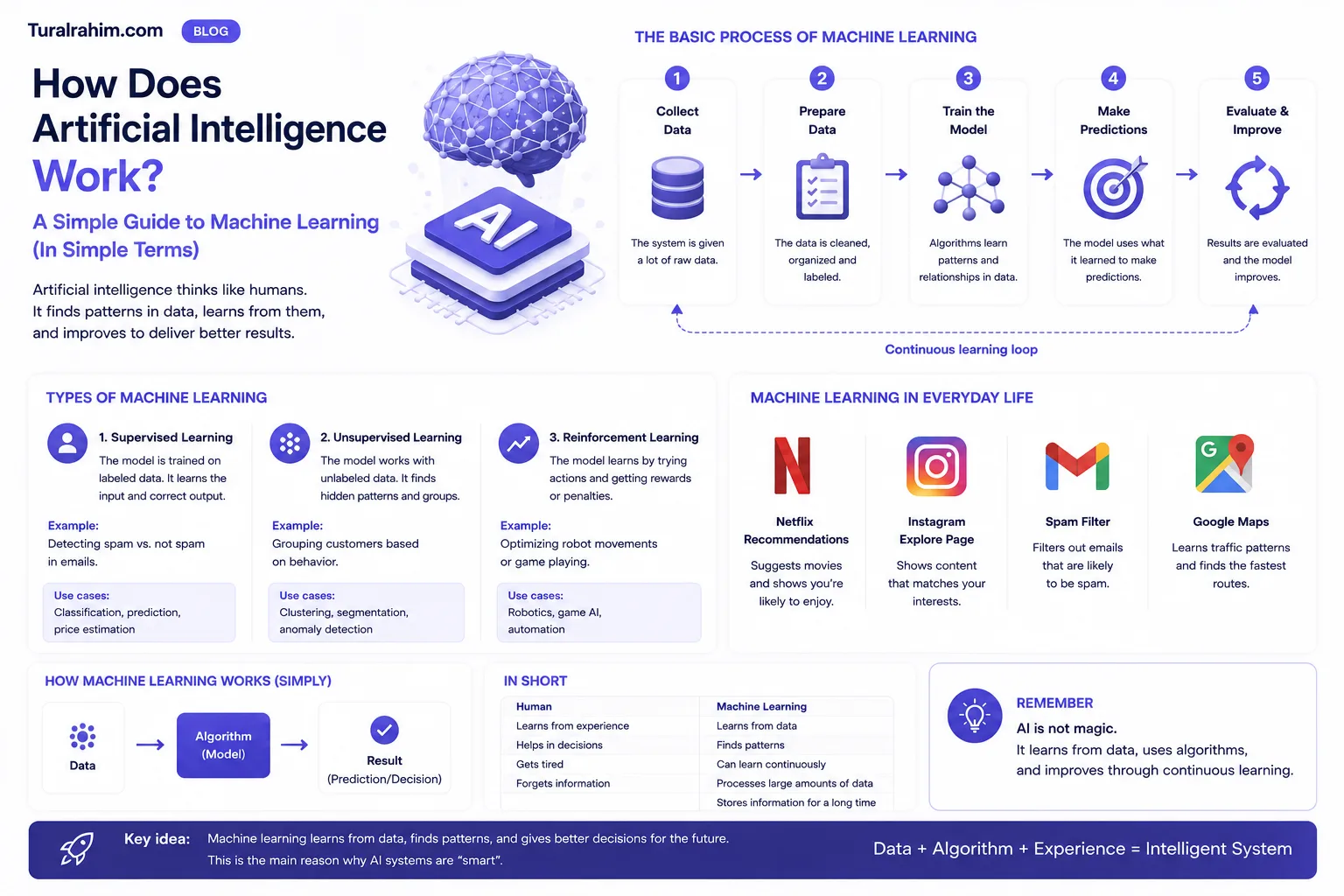
17 İyul 2026·⏱ ≈12 min
How does artificial intelligence work?
Machine learning, tokens, context windows and generative AI: I explain how artificial intelligence works, step by step, with no technical knowledge required.
Read →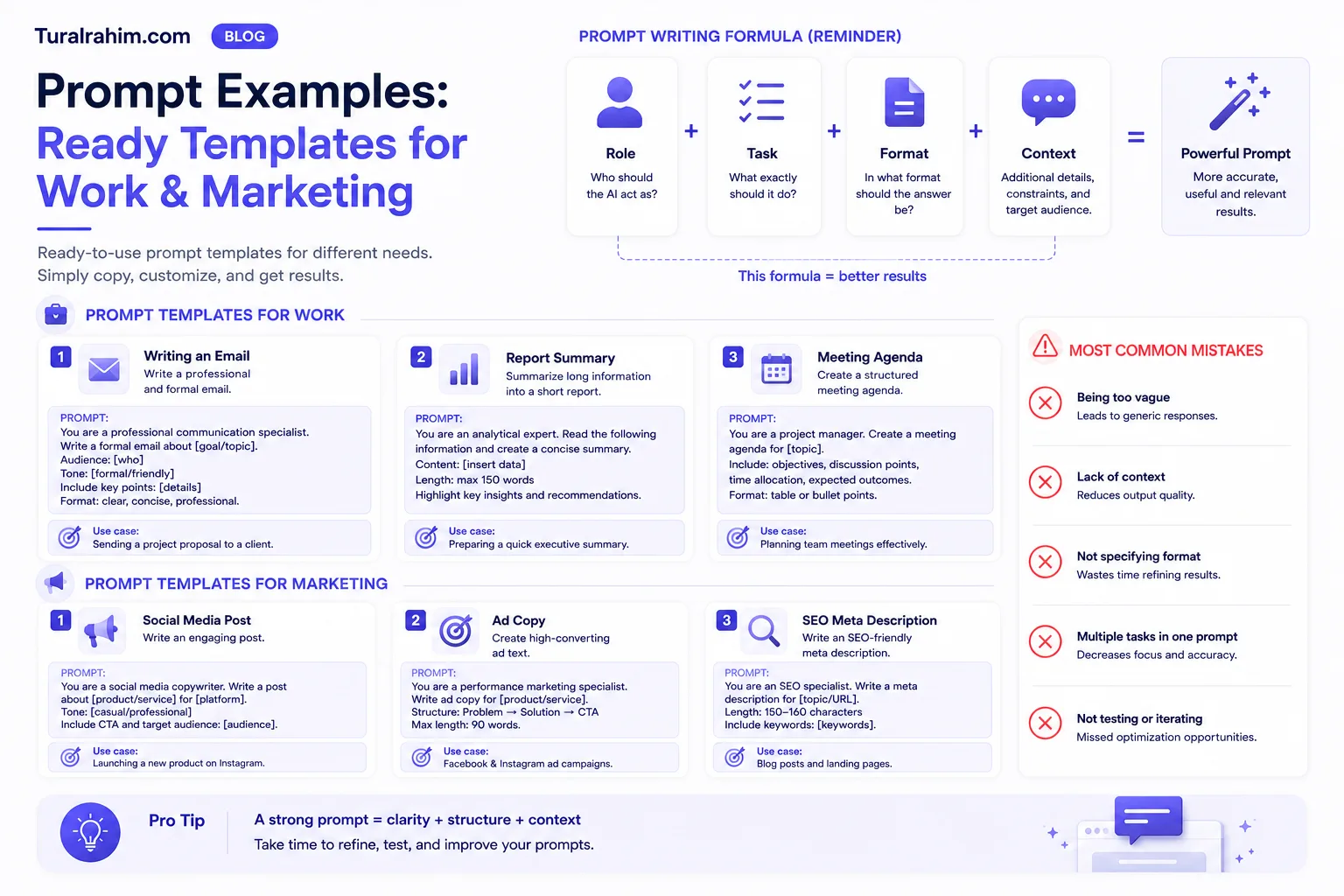
17 İyul 2026·⏱ ≈11 min
Prompt examples: ready-to-use templates for work and marketing
20 ready-to-use prompt templates for writing, data analysis, content, research and decision-making. Copy, fill in the brackets and use.
Read →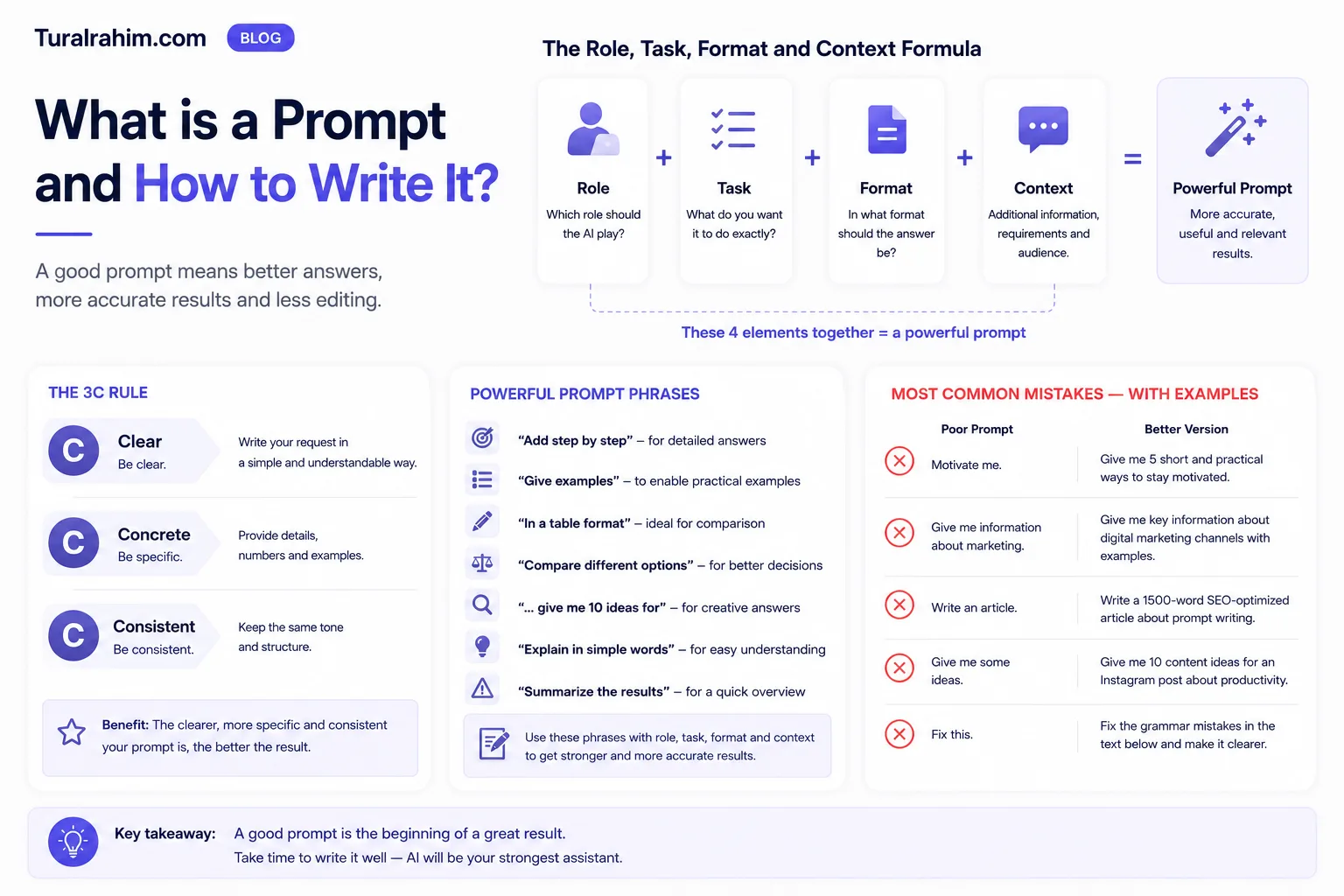
17 İyul 2026·⏱ ≈11 min
What Is a Prompt? Use the 3C Rule for Better AI Answers
What is a prompt and how do you write one? The role, task, format and context formula, the 3C rule, effective prompt phrases and common mistakes, with examples.
Read →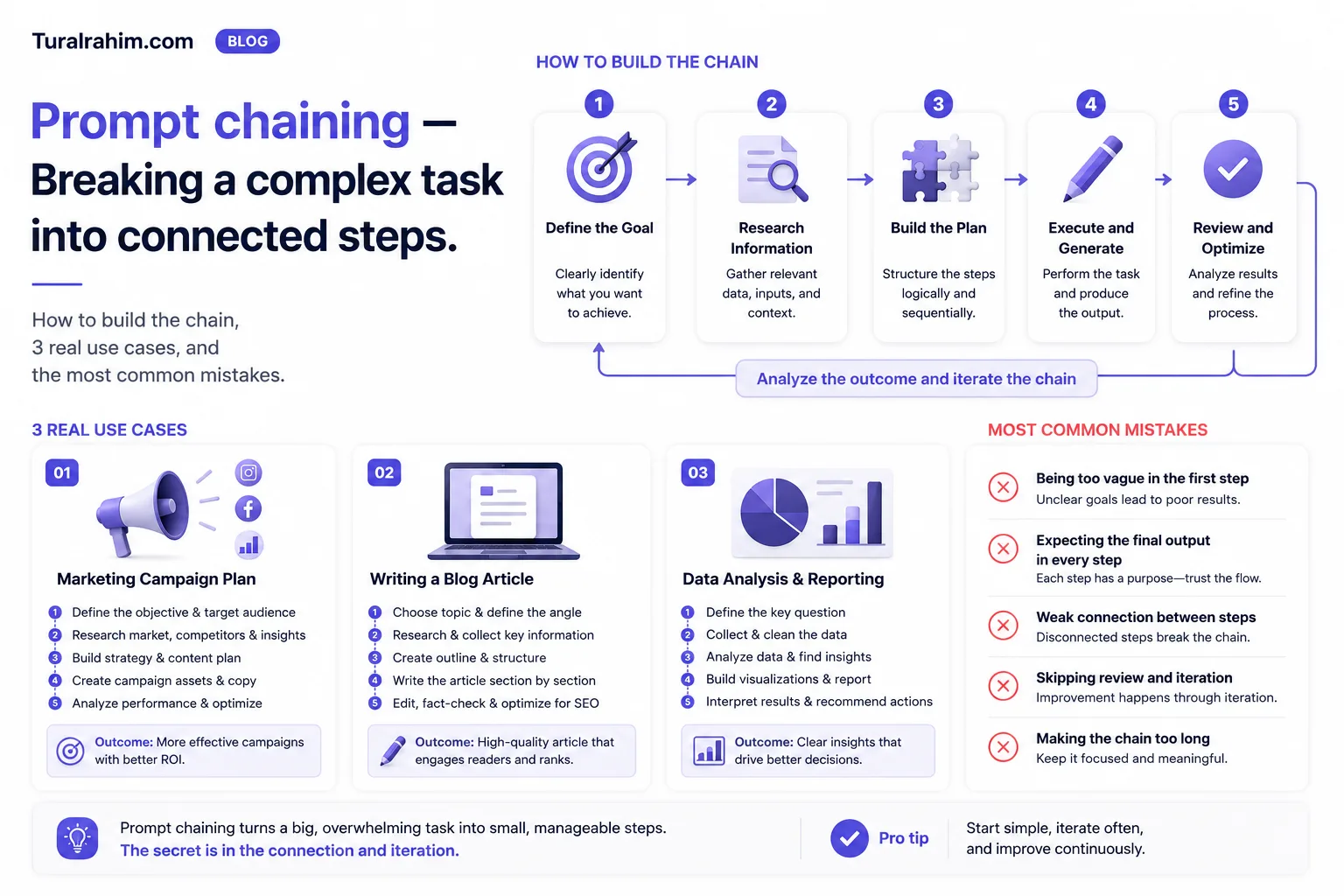
17 İyul 2026·⏱ ≈11 min
What Is Prompt Chaining? Solving Complex Tasks Step by Step
Prompt chaining: a method for breaking a large task into connected steps. How to build a chain, 3 real-world examples and common mistakes.
Read →
17 İyul 2026·⏱ ≈12 min
What Is Artificial Intelligence (AI)? A Complete Guide to Using It at Work (2026)
What is AI, how does it work and where should you start using it in your business? Prompts, tool selection, limitations and responsible use, explained simply.
Read →