What Is Prompt Chaining? Solving Complex Tasks Step by Step
17 İyul 2026·Updated: ·⏱ ≈11 min·👁 139 views
Contents
- 🤔 Why isn’t one prompt enough?
- 🔗 What is prompt chaining?
- 🧭 Prompt chaining: how to build a chain in 4 principles
- 📣 Chain example 1: advertising campaign
- 📊 Chain example 2: a report for management
- 💬 Chain example 3: making decisions from customer reviews
- 🎭 What is meta-prompting?
- 🔬 How can you test whether a chain works?
- ⚖️ A chain or a long prompt: what’s the difference?
- lets you check them separately
- The next section is about this.
- If fewer than two conditions apply, start with a good prompt and review the result.
- ❓ Frequently asked questions
- Conclusion
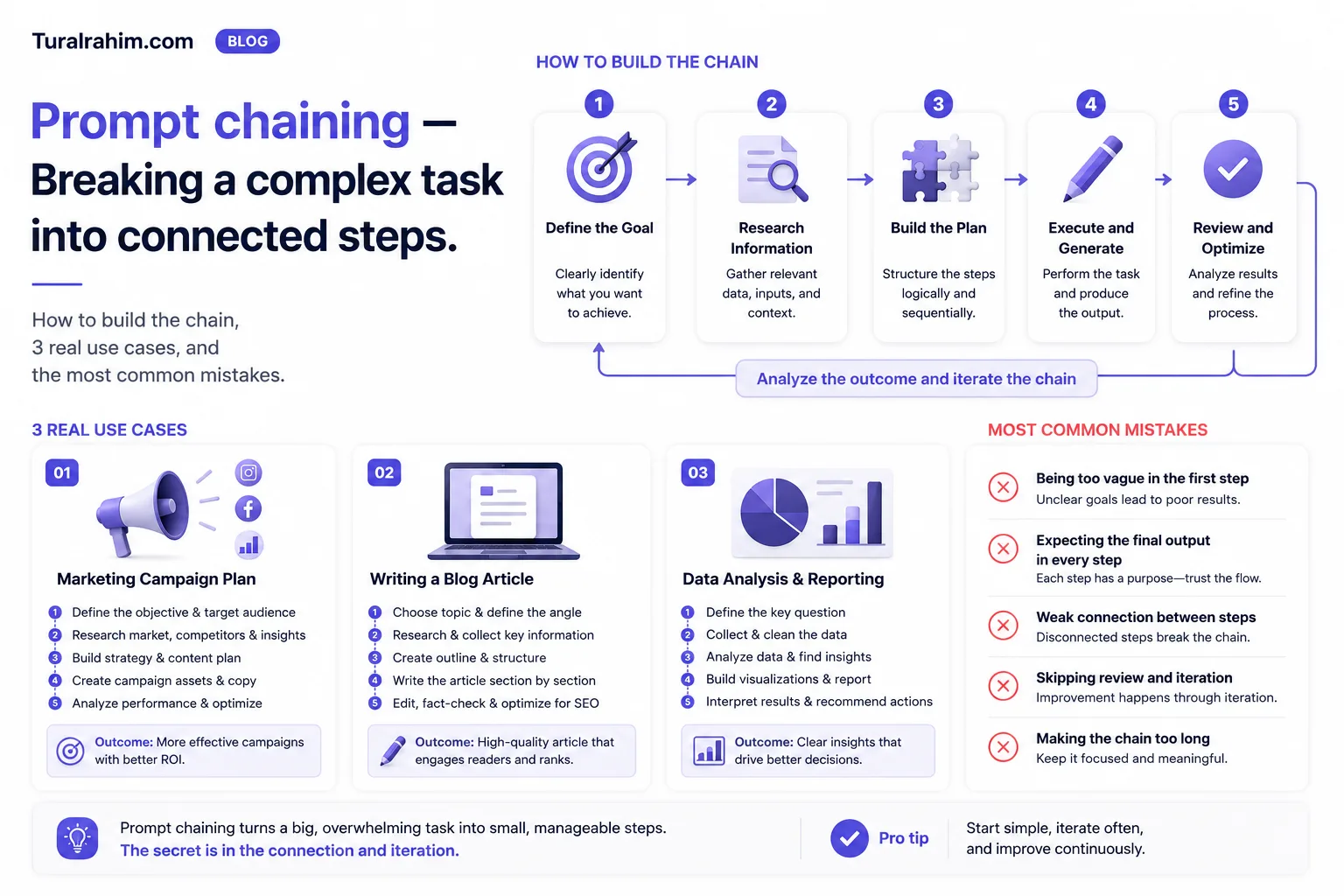
Prompt chaining (a chain of prompts): is a way to break a large task into smaller, connected steps instead of trying to complete it with one prompt. The response to each step becomes the basis for the next, and in this example, they all take place in the same conversation .
Think of it like an assembly line in a factory: the first machine makes a component, the second assembles it, and the third paints it. No single machine does everything at once. That’s how you get a high-quality result.
In this article, I’ll show you how to build a chain, share three examples from real work, and cover the most common mistakes. If you’re not yet familiar with the basics, start here: What is a prompt? The 3C rule. For the bigger picture: 🧐 What is artificial intelligence (AI)?
🤔 Why isn’t one prompt enough?
Let’s start with a familiar scenario.
You ask AI: "Create a marketing campaign for our new service: identify the target audience, develop the main message, choose the channels, allocate the budget, write a content plan, and show how we’ll measure the results."
The answer arrives. It’s long, neatly structured and has headings. But as you read it, you realise that each section consists of just two sentences of generic advice. Audience: “people aged 25–45”. Channels: “social media and Google”. Budget: “test and optimise”.
What happened? You packed six tasks into one sentence. The model may not be able to handle each one in enough detail. As a result, all six may end up superficial.
Give the same task to a person and you might get a similar result. Tell a new colleague, “Set up a campaign today, allocate the budget, write the content and build a measurement system,” and by the end of the day you may have a half-finished piece of work.
The golden rule: AI has limits when it comes to complex tasks. When you ask it to do too much in one prompt, some parts may lack depth. A chain helps you focus on one task at each step.
🔗 What is prompt chaining?
Let’s start with a simple example: planning a trip.
With one prompt: "Plan a 3-day trip to Georgia." The result may be a generic list you’ve seen many times online.
With a chain:
Prompt 1: "I’m going to Georgia for 3 days. I like history, architecture and local cuisine, but I don’t like crowds. List places worth visiting."
Prompt 2: "Create a 3-day itinerary using these places, with as little time on the road as possible."
Prompt 3: "Suggest local restaurants near the places I’ll visit along each day’s route."
See the difference? By the third prompt, AI can take into account what you like, which places you’ll visit and the order in which you’ll see them. Each step builds on the previous one.
This turns AI from a tool that gives answers into a colleague .
🧭 Prompt chaining: how to build a chain in 4 principles
1. Start at the end and work backwards
First, ask yourself: what do I need to have at the end? Finished ad copy? A report? A plan?
Then work backwards: what do you need in the step before to get that result? And what do you need before that?
That’s how the chain takes shape. Many people do the opposite: they start at the beginning without knowing where they’re headed, and the chain falls apart halfway through.
2. Give each step one task
The rule is simple: one step = one verb. List. Choose. Build. Write. Critique. Revise.
If you see the word “and” in a step (“list and and choose”), it probably needs to be split in two.
3. Check each step
The biggest advantage of a chain is this: you can catch mistakes early.
If you ask for everything in one prompt, a mistake may only become clear at the end, and you may have to start all over again. With a chain, if something goes wrong at step 2, you can fix it there and then. The mistake won’t carry over to step 5.
So after each step, pause for a moment and review the answer. If you’re not happy with it, don’t move on to the next step.
4. Stay in the same conversation
The advantage of staying in the same conversation is that the model context window can “see” the previous steps in it. If you start a new conversation, copy over the relevant context and interim results so the chain can continue.
But bear in mind: as a conversation gets longer, earlier details may be lost or summarised. The limit depends on the length of the text and the tool, not the number of steps. In a long chain, restate important interim results as a short summary.
📣 Chain example 1: advertising campaign
Now let’s apply this to a real task. We’ll create a campaign for a small furniture shop in Baku.
Step 1: understand the market: "We’re a small shop in Baku that makes bespoke furniture. Our customers are families buying new homes. Our competitors compete on price. What might be the 5 biggest concerns for customers in this market?"
Step 2: choose: "Which of these concerns is directly connected to our strength, making furniture to precise measurements to order? Choose one and explain why."
Step 3: develop the message: "Write 3 different options for a key message based on the concern you chose. Each should be one sentence. Avoid overused phrases such as ‘quality’ and ‘affordable prices’."
Step 4: write the copy: "I like option 2. Based on it, write ad copy for Instagram: no more than 2 sentences, with a clear call to action at the end."
Step 5: critique: "Now imagine you’re a 38-year-old customer who’s tired of renovating and nearly out of budget. Read this copy and tell me what you don’t believe."
Step 6: revise: "Take these objections into account and rewrite the copy."
Six steps might take about 10 minutes. The result may be more specific than what you’d get from a “create a campaign” prompt, because you gave AI a clear sequence of tasks .
📊 Chain example 2: a report for management
What makes this chain distinctive is that it first asks AI to take into account who the report is for:
Step 1: "Extract the 7 most important points from the report I have attached."
Step 2: "Group these points according to the interests of two people: the finance director, who cares about budgets and revenue, and the operations manager, who cares about resources and timelines. Take each person’s priorities into account and briefly explain why the points you selected are relevant."
Step 3: "Write a short email for the finance director, with the selected points as bullet points."
Step 4: "Now imagine you’re that finance director. Read this email and write the 3 toughest questions you’d ask me."
Step 5: "What should I add to the email to be ready to answer these questions?"
Notice how step 2 spells out each manager’s priorities separately. This helps AI select relevant points from the same information for different audiences.
💬 Chain example 3: making decisions from customer reviews
Step 1: "Sort the 200 reviews below into these categories: price, quality, delivery, service and other. Count how many reviews are in each category."
Step 2: "Choose the category with the most complaints. Read the reviews in it and identify 3 specific recurring problems."
Step 3: "List possible causes for each problem. Which of these can I check using my own data?"
Step 4: "Choose the problem that can be solved most quickly and create a 30-day action plan."
What’s useful about this? You move from information to a decision and can pause at each step to ask, “Is this right?”
🎭 What is meta-prompting?
There’s another useful technique: ask AI to write its own instructions as the first step in the chain. This is one way to use meta-prompting.
One way to apply it is to define an expert role in detail, using two steps:
Step 1: "What are the key attributes, mindset and principles of an experienced SEO professional?"
Step 2: "You are that professional. Your attributes are: [paste the answer from step 1]. My role: [your role]. Now assess my [project]."
Why might this be more useful than simply saying, “You’re an SEO professional”? Because in the first step, the model spells out what the role involves: it sets out which principles to follow and what to focus on. In the second step, that detailed description gives it direction. This can guide the answer, but it doesn’t guarantee accuracy.
You can apply the same logic to the chain itself:
"I want to achieve [this result]. Break it down into steps and write what I should ask you at each step. Don’t start the work yet. Let’s agree on the plan first."
AI will give you a plan for the chain. You can review and revise it: “Step 3 isn’t needed; take this into account in step 2 as well.” Then you can start. This way, you’re sharing the work of planning too.
🔬 How can you test whether a chain works?
Don’t just take my word for it. Test it yourself in 15 minutes. It’s a simple test that helps you see the difference.
Choose a real work task, not a made-up one. Then:
In the first conversation, ask for everything in one prompt. Save the answer.
In a second conversation, (start a new conversation so the previous context doesn’t influence the result) break the same task into 4–5 steps.
Place the two results side by side.
What should you look for? Specificity. The first answer may contain generic advice such as “identify the target audience”. The second may give you concrete points relevant to your business because you added context at each step.
Also compare the time. A chain may take longer: for example, 10 minutes instead of 2. Ask yourself how many minutes you’d spend improving the initial result, and include that in the comparison.
⚖️ A chain or a long prompt: what’s the difference?
They’re often confused, so let’s clarify the difference.
Long prompt: you provide a lot of information in one message. This can be useful: relevant context can improve the result. But excessive or irrelevant information can reduce the quality of the answer.
A redirect chainPrompt chain : you break several tasks into a sequence of steps. It’s not just about length, but about.
how the tasks depend on one another and how complex they are In other words, a useful approach is:
Sometimes people write "Step 1... Step 2... Step 3..." to a message under the name prompt chaining. This is not a chain of separate calls, but a multi-step prompt. The chain transfers the interim results to the next call and Some people write “step 1… step 2… step 3…” in a single message and call it “prompt chaining”. That’s a multi-step prompt, not a chain of separate calls. A chain passes interim results on to the next call and.
lets you check them separately
❌ What are the most common mistakes? Going through the steps in a hurry and only looking at the end result reduces the benefits of the chain. The error should be detected early.
Rushing through the steps and looking only at the final result reduces the value of a chain. You need to catch mistakes early. Unnecessary steps exaggerate context and make it difficult to follow through. You can try steps 4–7 to get started, but it's not a technical limit.
Unnecessary steps add to the context and make the work harder to follow. You could try 4–7 steps to start with, but that isn’t a technical limit. 3. Changing the subject halfway through.
Don’t interrupt the chain with “by the way, write this for me too”. An unrelated task can distract from the main one. If the answer to step 2 is poor, do not skip step 3. A poor foundation can also weaken subsequent results. Go back, fix the prompt.
If the answer to step 2 is weak, don’t move on to step 3. A weak foundation can undermine later results too. Go back and revise the prompt. 5. Building a chain for every task.
The next section is about this.
🚦 When should you avoid using a chain? Let’s be honest:
"Shorten this sentence", "synonymize this word", "write this letter in the official style": these are things to do with one prompt. Splitting them into steps can become time-consuming and rob you of your AI.
“Shorten this sentence”, “give me a synonym for this word”, “rewrite this email in a formal style”: these are all jobs you can do with one prompt. Breaking them into steps can waste time and put you off using AI.
As a practical rule of thumb, try a chain if at least two of these three conditions apply: The task involves several different tasks
Conclusion (research + choose + write).It’s important
: it will be shared with a client or manager. The next step depends on the previous answer
.
If fewer than two conditions apply, start with a good prompt and review the result.
In practice, a lot of work fits into a few typical chain structures. If you keep these in mind, you won't be thinking from scratch every time.
In practice, many tasks fit a few common chain structures. Learn these and you won’t have to start from scratch every time.
Creation chain
Research → Choose → Build → Critique → Revise
Suitable for content, advertising and offers: many tasks where you’re creating something. The campaign example above uses this structure.
Understanding chain
Summarise → Explore in depth → Investigate causes → Decide
If you’re working with data, a report or lots of feedback, try this structure. It takes you from the general to the specific.
Decision chain
List the options → Compare → Ask for counterarguments → Choose
If you’re facing an important decision, don’t skip the third step. AI may tend to agree with you, so ask for counterarguments explicitly.
Preparation chain
Provide the material → Review it from the audience’s perspective → Identify questions → Prepare answers
❓ Frequently asked questions
Suitable for presentations, meetings and interviews: tasks where you’re preparing to communicate with people. This chain helps you prepare for difficult questions in advance.
You can try steps 4–7 to get started. But two steps can be a chain, and more steps can be needed. Do not specify the number in advance: list the natural steps of the case, and the count itself will be clarified.
You could try 4–7 steps to start with. But a chain can have just two steps, or it may need more. Don’t decide on the number in advance: list the task’s natural steps and the right number will become clear.
Do I need to rewrite the chain every time? No. This is one of the most useful tips. Copy a chain that works move. You can use the same 6 steps in the next promotion, just change the details.
. For your next campaign, you can use the same 6 steps and just change the details.
Which tool is best for chaining? it works because it is possible to set the chain on different instruments. In long chains, a large context window can be useful, but the result also depends on the task and the quality of the model.
work, because you can build a chain in different tools. A larger context window can be useful for long chains, but the result also depends on the task and the quality of the model.
Yes, it's a good way to get started. Tell him, "I want to get [such a result]. Break this down into steps and write down what I need to ask you every step of the way.“ The AI will give you the chain plan. You'll also get it fixed and up and running.
Yes, it’s a good way to get started. Tell it: “I want to achieve [this result]. Break it down into steps and write what I should ask you at each step.” AI will give you a plan for the chain. You can then refine and use it.
Stop and fix it like this: “You misunderstood [it] in this step. The correct option is […]. Please do this step again.“ Then go ahead. The advantage of the chain is that it's possible to come back.
Stop and fix it there and then: “You misunderstood [this] in this step. The correct version is [...]. Redo this step.” Then carry on. The chain’s advantage is precisely that you can go back.
Does a chain save time or take more time? The honest answer is: For example, a prompt may take 2 minutes, a six-step chain may take 10 minutes. But take the account at the end: how long do you take to make a single prompt's response work? If the adjustment takes half an hour, it can be verified when you advance the chain.
For example, one prompt may take 2 minutes, while a six-step chain may take 10. But look at the total time: how long does it take to turn the answer to a single prompt into something usable? If revisions take half an hour, the time you invested in the chain may pay off.
Yes, that's one of the benefits. If you write a working chain document and give it to the team, everyone can use the same sequence of work. You'll need to double-check your results. Likewise, from your personal method of chain Yes, that’s another benefit. Write an effective chain in a document and share it with your team so everyone can follow the same sequence of tasks. You’ll still need to review the results. This way, a chain can go from being your personal method to a team standard
Conclusion
. Prompt chaining isn’t a technical trick. It’s simply
Think about it: you're not setting up a promotion all at once. First you think, then you choose, then you write, then you show up to someone and get feedback. Here's what the chain looks like: Think about it: you don’t create a campaign all at once either. First you think, then you choose, then you write, and then you show someone and get feedback. That’s what a chain is:
breaking your own workflow into steps and sharing it with AI. That’s why the hardest part of learning this skill has nothing to do with AI: you need to know the steps in your own work clearly.
Do something this week: always pick one important thing you do with a prompt and break it down into 4 steps. Compare the result to see which approach works best for your business.
Try this week: choose an important task you usually do with one prompt and break it into 4 steps. Compare the results and see which approach works better for you.
A reminder: don’t use a chain for every task. Keep short tasks short. A chain is your heavy-duty tool. Save it for complex tasks where the outcome matters, or you may quickly get tired of it and give up altogether. Writing and communication with AI
To turn these insights into campaign decisions, my media planning and strategy service visit my page.
Topic: Artificial Intelligence: posts in this topic →

About the author
Tural Rəhimov
Digital Marketing Manager: UM Azerbaijan
Digital marketing manager at Universal McCann (UM Azerbaijan). Experienced in Google Ads, Meta Ads, TikTok Ads and media planning. I help brands grow online.
More about me →Need digital marketing support for your business?
Let's talk: I can help with everything from strategy to ad management.