What Is a Prompt? Use the 3C Rule for Better AI Answers
17 İyul 2026·Updated: ·⏱ ≈11 min·👁 311 views
Contents
- 🧐 What is a prompt?
- 🧱 What are the 4 elements of a good prompt?
- 📏 What is the 3C rule?
- 💪 Which prompting phrases work best?
- 🔍 How should you evaluate the response?
- 🔄 What if you don't like the first response?
- 📎 Providing a reference: "Write something like this"
- 🗂️ When should you start a new chat?
- 📚 How do you build your own prompt library?
- 🎯 How can you improve your prompting skills in a week?
- ❌ What are the 5 most common prompting mistakes?
- ❓ Frequently asked questions
- Conclusion
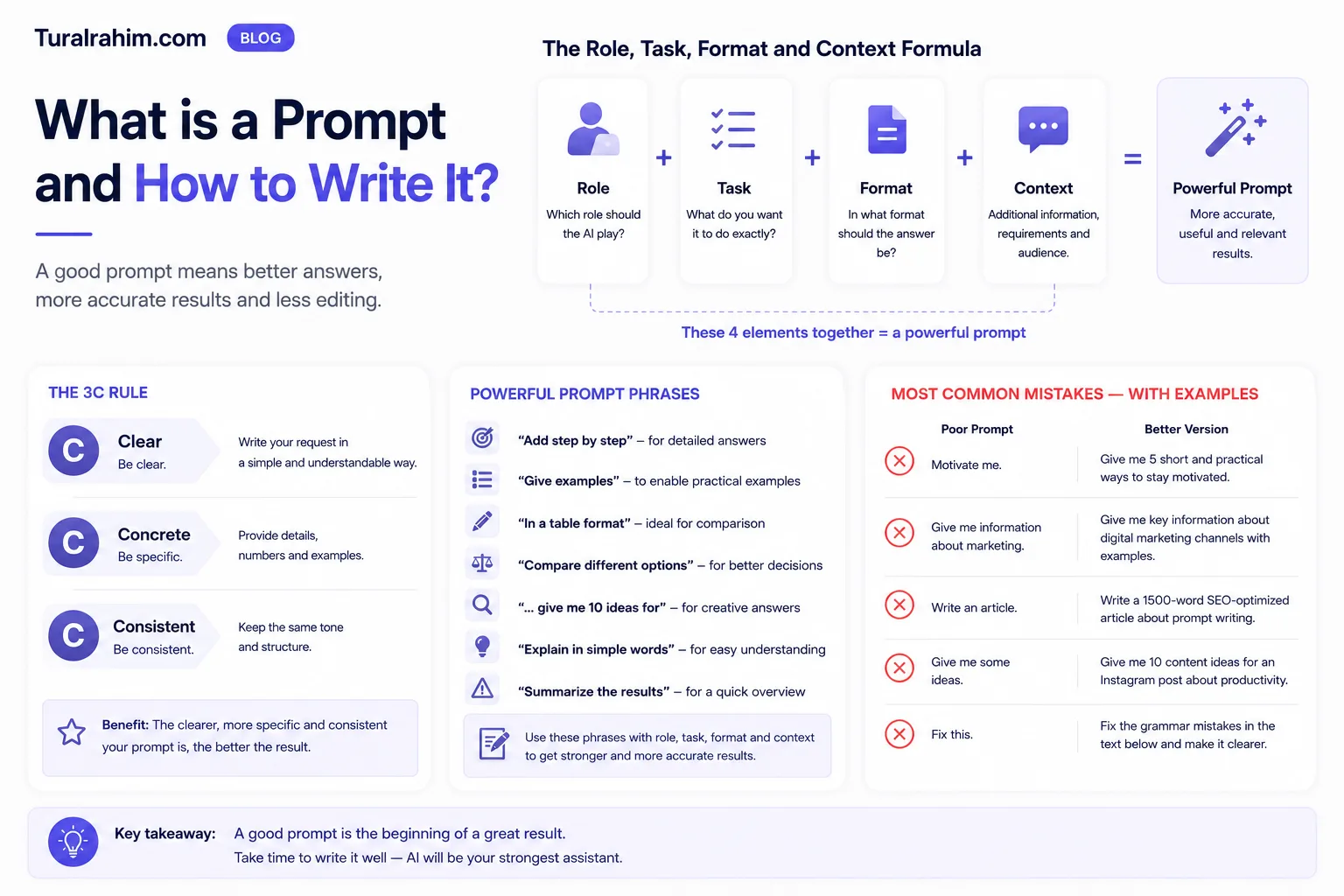
Prompt: an instruction you give to AI. It can be a simple question, while a more complete prompt specifies whose perspective to adopt (role), what to do (task), how the answer should look (format) and what background information is needed (context). The formula for a good prompt is: Role + Task + Format + Context.
One reason people say "AI doesn't work" is often that the tool has been given a poorly defined task. In this article, I'll walk you through the four elements of a prompt, the 3C rule and how to improve your results. I'll finish with the most common mistakes so you can avoid them.
This article is part of the 🧐 What is artificial intelligence (AI)? guide.
🧐 What is a prompt?
Let's start with a familiar situation.
You're at work, and a colleague is taking everyone's lunch orders. You say, "A doner kebab for me." Fifteen minutes later, you get a chicken doner with hot sauce and no pickles . But you wanted beef, and you can't handle spicy food.
Is your colleague to blame? No. They wanted to help; you simply hadn't told them what you wanted. So they filled in the gaps with their own assumptions.
Working with AI is much the same. It is ready to help and can fill in the gaps itself. The question is: are you filling in the gaps, or is it?
Saying "Write me some ad copy" is like saying "A doner kebab for me." The result will reflect that: generic, average copy that speaks to no one in particular.
The golden rule: AI doesn't know what you want. It relies on what you write . Bridging that gap is your responsibility.
🧱 What are the 4 elements of a good prompt?
A good prompt doesn't happen by chance. It is carefully structured around four elements, each with a specific purpose.
1. Role: who should the AI be?
Tell the AI whose perspective to take. This helps establish which area of expertise it should draw on.
Example: "You are a digital marketing specialist with 10 years of experience."
The more precisely you define the role, the more specific the response can be. "You are a marketer" is a weak example. "You are a performance marketing specialist who helps small businesses grow on limited budgets" is stronger. The second version also signals which advice would be unsuitable.
One particularly useful technique: ask the AI to take the role of your audience. "You are my potential customer: a busy 35-year-old parent who has just bought a home." Then ask it to evaluate your copy.
Why does this work? The model builds its response around the text you provide. Without a role, it may give a more general answer. Assigning a role guides it towards the language, approach and details relevant to that field.
It's easy to test the effect: ask the same question first without a role, then with one. Compare the responses.
2. Task: what should it do?
Everyone includes this part, but many leave it incomplete. Use a precise action verb.
Weak: "Say something about this."
Good: "Write 5 different headline options for this service."
See the difference? The second version makes it clear what the AI should do (write), what it should produce (headline options) and how many options you need (5).
3. Format: how should the answer look?
This is the most frequently overlooked element, yet it offers some of the biggest benefits for the least effort.
Example: "Give your answer as bullet points, with no more than one sentence per point."
Without a specified format, AI may give you a lengthy, essay-style response in paragraphs. Often, all you need is a short list.
Useful format instructions: as bullet points · as a table · 3 paragraphs · maximum 100 words · in a formal tone · in plain language, without jargon · as questions and answers · as step-by-step instructions.
One small detail makes a big difference: specify the length with a word count, rather than saying "short". "Short" means different things to different people, but 50 words is the same length for everyone.
4. Context: what does it need to know?
This is one of the most important elements, and you are best placed to provide it accurately.
AI doesn't know your customers, your team, your budget or last year's unsuccessful campaign. Without that information, it may imagine a "typical" company and respond accordingly.
Example: "We run a small furniture shop in Baku. Our customers are mainly people aged 30–45 furnishing family homes. Our budget is limited, and our last Instagram ad campaign didn't deliver results."
That one sentence can make the response far more relevant to your business.
Putting it all together: before and after
Let's look at a practical example of the difference.
Weak prompt:
"Write ad copy for my furniture shop."
The response might be: "Give your home a stylish touch! Quality furniture at affordable prices!" In other words, copy that could appear in almost any furniture shop's advertising.
Strong prompt:
"You are an experienced copywriter who works with small businesses. (Role)
Write 3 different versions of copy for an Instagram ad. (Task)
Each version should be no more than 2 sentences and end with a clear call to action. Do not use emojis. (Format)
We run a small furniture shop in Baku. Our customers are people aged 30–45 who have just bought a family home. Our competitors compete on price, and we cannot match them on that. Our strength is making furniture to the customer's exact dimensions. Our last ad focused on 'low prices', but it didn't deliver results. (Context)"
The second prompt provides more information to help produce a response that suits your business. Notice: the tool is the same. Only the instructions you give it have changed.
There is no fixed order. You can put the role at the end and the context at the beginning. What matters is that the task is clear and the necessary elements are included.
📏 What is the 3C rule?
If the four elements form the structure of a prompt, the 3C rule helps you assess its quality.
Concise
Focus on one main task per prompt. Don't squeeze five tasks into one sentence: tangled requirements can cause the model to overlook some of them.
A long prompt is not always a good prompt. Relevant context is useful; a confusing list of tasks can make the job harder.
Clear
One of the most common and least specific prompts is: "Make this better."
Better in what way? Shorter? Longer? More formal? Simpler? If you don't specify, the AI decides for itself and often chooses something other than what you wanted.
Instead, write: "Shorten this to 3 sentences and make the tone more formal."
Consistent
Use the same name for the same thing. Don't call something a "table" at the start of a conversation, a "matrix" halfway through and a "sheet" at the end. The model may interpret them as different things.
This is especially important in long conversations.
💪 Which prompting phrases work best?
There are no magic words. But some phrases can guide the model towards a more systematic approach to the task. They tell the AI not only what to do, but also how to do it . Try adding the following to your prompts and compare the results.
Give it a process
"Think step by step." This phrase can help with some models. Reasoning models already do this internally, so they may not need the instruction, and it could even reduce the quality of the result.
"First do [this], then [this], and finally [this]." You define the sequence yourself.
Ask for criticism
These phrases are used less often, but they can be very useful:
"Take the opposing view. What is the strongest argument against this idea?"
"Critique this from the perspective of [role]." For example, from the perspective of a customer who is sensitive to price.
Why does this matter? AI can sometimes be too agreeable. If you simply ask for feedback, it may offer little more than praise. The real value comes from identifying weaknesses.
Ask for alternatives
"Give me 3 different versions of this." One response can limit your perspective; three give you a choice.
"What is an alternative way to solve this problem?"
Set boundaries
"Discuss only [A]; do not cover [B]."
"Write a one-paragraph summary."
Explore further
"Expand on point 2." This asks it to expand only the part of a long response that you need.
"Give a specific example of this." This is one of the quickest ways to turn general ideas into something concrete.
Don't try to memorise these phrases. Just remember that you can specify the process as well as the desired result when needed. The key is to communicate the task requirements clearly.
🔍 How should you evaluate the response?
Writing the prompt is half the job. Checking the response is the other half. Assess it against four criteria:
Accuracy: Are the facts correct? Have the figures, names and dates been verified?
Bias: Is the response one-sided? Does it present only one perspective?
Relevance: Did it answer my question, or did it go off topic?
Consistency: Are the tone and quality consistent throughout? Sometimes the opening is excellent, but the ending is weak.
Anyone who skips these checks is trusting AI blindly. Checking the response is what separates a professional approach from an amateur one.
🔄 What if you don't like the first response?
One of the biggest misconceptions is that a good prompt should produce a perfect answer on the first attempt. In practice, improving the result may take several rounds of revision.
If the response isn't what you wanted, you have three options:
Strengthen the elements. Make the role more precise, the context more complete and the format more specific.
Break down the task. Don't ask for everything at once: start with ideas, then the structure, then the copy.
Add a constraint. "Maximum 50 words", "discuss only pricing, not delivery", "avoid jargon".
Setting constraints is particularly useful. Telling AI what not to do can sometimes be more effective than telling it what to do.
📎 Providing a reference: "Write something like this"
Sometimes it's hard to explain what you want, but easy to show it.
Add a piece of writing, an image or a document you like to your prompt and say: "Write in this style." Or try the opposite: "I don't like this text. Explain why and write a better version."
One essential step: explain why you are providing the reference. Simply uploading a file isn't enough. Say: "This was our most successful post last year. Match its tone." Otherwise, the AI will have to guess why you supplied it.
🗂️ When should you start a new chat?
Remember the context window from the second article? This is where its practical implications become clear.
If you discuss ad copy, a budget report and a job advert in the same chat, AI may bring details from an earlier topic into a new response. The result can look strange, and you may not understand why.
The rule is simple: start a new chat when the topic changes. This simple step helps prevent different topics from getting mixed together.
📚 How do you build your own prompt library?
This could be one of the most useful tips in the article, yet it is often overlooked.
Found a good prompt that delivered an excellent result? Copy it into a document. Here's why:
You may not remember it two weeks from now.
Writing the same instructions from scratch every time wastes time.
If you switch tools, you can take your prompt library with you. Your chat history may not transfer automatically.
A simple Google Docs document is enough. A year from now, you'll have a collection of prompts tailored to your work . This can give you a competitive advantage because it is built around your own experience and needs.
🎯 How can you improve your prompting skills in a week?
You learn to write prompts by writing them, not just reading about them. If you close this article without trying anything, nothing will have changed a week from now. So here's a practical exercise.
One prompt a day for five days
Each day, choose a real work task : something you need to do tomorrow, rather than an invented exercise. Write the prompt twice:
First attempt: write it quickly, as it comes to mind. This will reveal your existing habits.
Second attempt: use all four elements: role, task, format and context.
Then compare the two responses side by side. After five days, you'll see the difference for yourself. You won't need me or another article to convince you.
The hardest part: providing context
Context will probably be the hardest part of this exercise. The reason is revealing: you know your own work so well that you forget to explain it. Things that are obvious to you, such as who your customers are, what didn't work last time and how much budget you have, are unknown to AI.
Ask yourself this helpful question every time: "If I were giving this task to a new colleague starting today, what would I need to explain?" Your answer is the context.
❌ What are the 5 most common prompting mistakes?
1. Leaving out context. This is the mistake I see most often. AI doesn't know your business, so give it the information it needs.
2. Using vague instructions such as "make it better". Specify what should change, how it should change and by how much.
3. Using the first response without editing it. Treat it as a draft. Your input makes it relevant to your work.
4. Asking for everything in one prompt. Break the task into smaller parts.
5. Failing to check the result. Your name is on it, and the responsibility is yours.
❓ Frequently asked questions
How long should a prompt be?
There is no fixed length. The rule is: provide as much context as needed, and keep the task as short and clear as possible. A paragraph of context and one precise sentence defining the task is often a good starting point.
Should I write prompts in Azerbaijani or English?
For simple tasks, feel free to write in Azerbaijani. For complex, lengthy tasks, writing in English and asking for the result to be translated into Azerbaijani usually works better. I've explained why in the comparison article .
Do I need to say "please" to AI?
It doesn't make a major difference to the result, but you lose nothing by being polite. Some studies also suggest that polite prompts written in complete sentences perform slightly better. The reason is simple: polite writing tends to be clearer and more complete.
Does the same prompt work across different tools?
Generally, yes. You can try the role + task + format + context approach in ChatGPT, Gemini and Claude. For the best results, though, you may need to adapt the prompt to the model you are using.
I get a different response to the same prompt every time. Am I doing something wrong?
No, this is normal. The model generates text based on probabilities, so it can give different responses to the same prompt. For more consistent results, define the format and constraints precisely. Instructions such as "3 bullet points, one sentence each, no emojis" help produce responses with a similar structure. You can guide the response's structure , but you cannot determine every word in advance.
Can AI write my prompt for me?
Yes, and this can be useful. Say: "I want to ask you to do [this task]. What prompt should I give you to get the best result?" The AI will write a prompt that you can refine and use.
Conclusion
Writing prompts is more than a technical skill; it is the ability to think clearly. If you can't explain to AI what you want, it is probably because you haven't clearly defined it for yourself.
That is why this skill benefits the rest of your work too. Learning the four elements, role, task, format and context, also helps you delegate to colleagues and write better briefs.
Try one thing today: take your last weak prompt, add the four elements and compare the results. This exercise can teach you a lot because you'll see the difference in your own work.
If you'd like ready-made templates, I've collected examples you can copy and use here: Prompt examples: ready-made templates for work and marketing. For larger tasks that won't fit into a single prompt: What is prompt chaining?
To apply these skills to campaign planning, visit my media planning and strategy service my page.
Topic: Artificial Intelligence: posts in this topic →

About the author
Tural Rəhimov
Digital Marketing Manager: UM Azerbaijan
Digital marketing manager at Universal McCann (UM Azerbaijan). Experienced in Google Ads, Meta Ads, TikTok Ads and media planning. I help brands grow online.
More about me →Need digital marketing support for your business?
Let's talk: I can help with everything from strategy to ad management.