What is Prompt? 3C Rules for Getting the Right Answer from AI
17 İyul 2026·👁 16 views
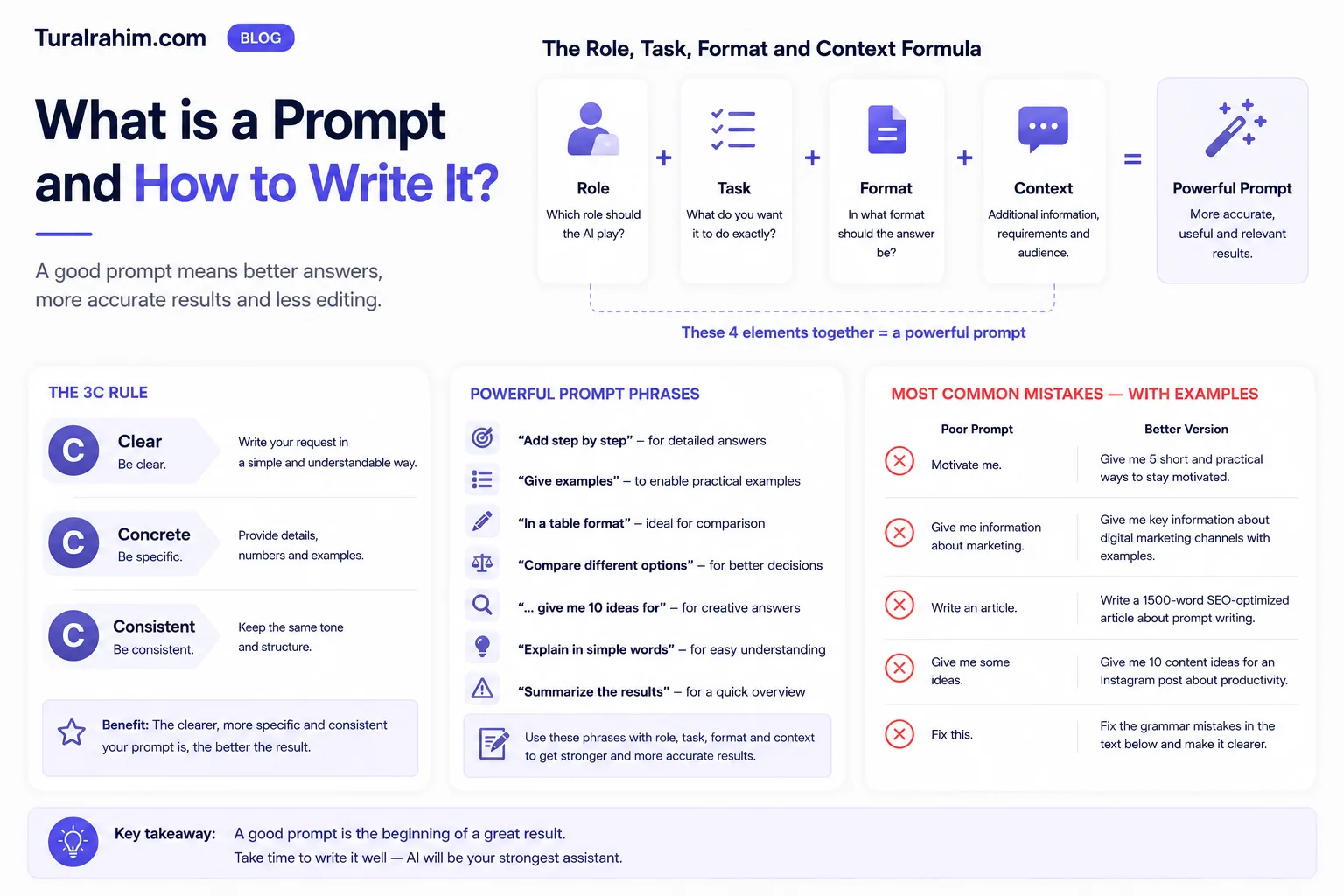
Prompt — Here's your guide to AI. It's not just a question: it's a task that incorporates who will speak the language (role), what they will do (task), what the answer will look like (format), and what they need to know (context). The formula for a good prompt is Role + Task + Format + Context.
It's almost always the same why people say, “AI doesn't work” — not a tool, poor given task. In this post, I'll show you step by step how to improve the four elements of prompt, rule 3C, and output. In the end, I'll list the most common mistakes so you don't have to repeat them.
This post What is Artificial Intelligence (AI)? is part of its guide.
What's 🧐 Prompt?
Let's start with a scene.
You're at work, a colleague is picking up everyone's lunch order. You say, "Back to me one." You're welcome in fifteen minutes chicken turnip, with bitter sauce, acid-free it is put on hold, although you wanted a meat loop and you don't tolerate bitterness.
Is your colleague guilty? No. He wanted to help you — you just didn't say what you wanted. He also filled the spaces with his own imagination.
This is exactly how you deal with AI. They're here to help and will fill in the gaps themselves. Here's the question: do you fill in the spaces or is it?
“Text me an ad” — this means “back to me.” The result will also correspond to: a text that appears everywhere, not related to anyone, in moderation.
Golden Rule: AI doesn't know what you want-it's you what you wrote he knows, and the difference between them is entirely your responsibility.
4 🧱 Elements of a Good Prompt
A good prompt isn't an accident, it's a structure. There are four elements, each doing something specific.
1. Role — Who is AI?
Tell us who's going to look at AI through their eyes. This determines what field of knowledge they'll be talking about.
Example: “You're a digital marketing expert with 10 years of experience.”
The more accurate you give the role, the more focused the answer is. “You're a marketer,” he said. “You're an expert in performance marketing, growing small businesses on a limited budget.” In the second one, the model already knows what advice to give.
A particularly useful trick: make the role your own audience. “You're a potential client of mine — a 35-year-old, buying a new home, with little time for you." Then ask them to rate your own text.
Why does it work, because the model is probably working. When she doesn't give a role, she replies, "The average internet user." When given a role, it moves to the language, logic, and details of the field.
It's easy to test the power of roleplaying: ask the same question before and after. The difference is obvious.
2. Assignment — what does it do?
Everyone writes here, but most of them write unfinished. The verb must be precise.
Weak: “Say something about it.”
okay “Write 5 different header options for this service.”
See the difference? In the second, it's clear what AI will do (spring), how much (5), and what (title option).
3. Format — how does the response look?
It's the most forgotten element, and it's the most beneficial with the least pain.
Example: “Leave the answer in the form of ingredients, and each item should be no longer than one sentence.”
If you don't, AI usually responds with a long, abridged, “essay” because that's how most of the texts it learns. And you often need a shortlist.
Phrases you can use for the format: in the form of items · in the form of a table · 3 paragraphs · up to 100 words · official tone · in simple language, without using a term · in the form of a question and answer · as a step-by-step guide.
A small detail, a big difference: say the length in words, Don't say "short." Short is something else for everyone — and 50 words are the same for everyone.
4. Context — what should be known?
That's the most important element, and only you can give.
AI doesn't know your client, your team, your budget, your failed campaign last year. If you don't, they'll imagine a “typical” company responding to it.
Example: “We have a small furniture store in Baku, our customers are primarily families between the ages of 30 and 45, our budget is limited, and last time, an Instagram ad didn't work out.”
This one sentence doubles the quality of the response.
Let's connect all: before and after
Now let's see the difference in a real example.
Weak prompt:
“Write promotional text for my furniture store.”
The predictable answer is: “Add charm to your home! Quality furniture, affordable price!" — that's the text used by every second store in Baku.
Strong prompt:
“You're an experienced copywriter working for a small business. Role
Write 3 different text options for Instagram advertising. Assignment
Each option should have a maximum of 2 sentences, with a specific challenge at the end. Use emoji. Format:
We have a small furniture store in Baku. Our clients are families between the ages of 30 and 45 who are buying a new home. Our competitors compete on price, and we can't compete — our advantage is the size of the order. Last time we advertised with a 'low price' message, it didn't work. Context:"
The response of the second prompt will be comparably better than the first. Please note — tool is the same. The only variable is what you say.
Order is not important. You can type the role at the end, in the beginning of the context — it's all about the four of them.
Rule 📏 3C: Short, Clear, Consistent
If the four elements are the prompt's skeleton, 3C is its quality.
Short (Concise)
One task in one prompt. Don't put five things into the same sentence — the model doesn't know which one to focus on and makes it all incomplete.
Long prompt = not a good prompt. Long Context: useful; long Task List but it's harmful.
Clear
Most used and most useless prompt: “Make it better.”
What could improve? Shorten? Extend? Make it official? Simplify? When you don't, AI decides itself and often doesn't choose what you want.
Instead: "Shorten this to 3 sentences and clear the tone."
Consistent
Give the same thing the same name. Don't say "matrix" in the middle of what you call a "table" at the beginning of a conversation, or "sheet" at the end. The model may understand these as different things.
This is especially important in long conversations.
💪 Powerful Prompt Phrases
There are no magic words, but there are some phrases that make a model leads to deeper thinking. These are not what to do to AI, how to do it says. Add the following to your prompt-you 'll see the difference right away.
Give them a process
“Think step by step.” — This short sentence seriously improves the outcome in complex matters. The model doesn't rush the answer, it opens the steps.
“First [do it], then [do it], then [do it].” — You put the sequence yourself.
Ask for criticism
These group phrases are the least used and most common:
“Be the devil's advocate. What is the strongest counterargument to this idea?”
“Criticize it with [role] eyes.” — Example: price-sensitive customer eyesight.
Why it's important, because AI tends to agree with you in nature. If you want to hear them, they'll do it right. The value is in dispute.
Ask for options
“Give it 3 different options.” — An answer pulls you into it; three answers give you options.
“What's an alternative way to solve this issue?”
Set a boundary
“Just talk about [A], don't touch [B].”
“Write an abstract summary.”
Deepen
"Open Article 2." — Extends only the part you need from a long answer.
“Give it a specific example.” — The fastest way to get rid of common words.
Don't try to override these phrases. Just know that You can dictate the process, not the outcome to AI — and the real difference is there.
How to rate 🔍 response
Writing a promo is half the work. The second half is to check the incoming answer. Check out four criteria:
Accuracy and precision Are the facts correct? Number, name, date — checked?
Bias: Is the answer one-sided? Does it only provide one view?
Relevance Did it answer my question or deviate from the topic?
Sort Order: Is the tone and quality the same throughout the text? Sometimes the beginning is great and the end is weak.
The person who didn't do this check doesn't use AI — he blindly trusts her. The difference between the two sets the professional and the enthusiast apart.
🔄 Iteration: No First Response Last Response
One of the biggest misconceptions is that a good prompt should respond perfectly on the first try. In reality, professionals They fix 3-4 times.
If the answer isn't what you want, there are three ways:
Reinforce the elements. Be more precise in the role, richer in context, more specific in format.
Split the task. Don't ask for everything all at once — first idea, then structure, then text.
Please add a restriction. “Maximum 50 words”, “talk only about price, not delivery”, “don't use a term”.
It's a particularly powerful way to place restrictions. What's wrong with AI don't it's okay to say that, sometimes, it's okay to say what to do.
📎 Reference: "Write Like This"
Sometimes it's hard to explain what you want — but easy to show.
Add a text, image, or document you like to prompt and say, “Write this style.“ Or vice versa: “I don't like this text, explain why and write better.”
Important: explain why the reference was given. All you have to do is throw in a little file — “this is our most successful post from last year, repeat the tone”. Or the AI will try to guess why you gave the reference.
🗂️ New Topic = New Conversation
In a second post remember the context window I explained? The practical outcome shows up here.
If you discuss both the promotional text, budget report, and recruitment listing in a conversation, the AI will add the remainder of the previous topic to the new response. The result will turn out strange, and you won't understand why.
The rule is simple: topic has changed — please open a new conversation. It's free, one-click, and avoids too many issues.
Set up 📚 your own Prompt Library
This is the most rewarding piece of advice in this article, and almost no one does.
Did you find a good prompt and get a great result? Move it to a document. because
You won't remember it until two weeks later.
Writing the same thing from scratch every time is a waste of time.
If you change the tool, your prompt library goes with you-your chat history doesn't.
Just a simple Google Docs file. In a year, you're on your way prompt collection rooted in your own work it will — and it's a real competitive advantage of yours, because no one can copy it.
How to 🎯 Build a Prompt Skill in a Week
Writing a Prompt is not learned by reading-it is learned by writing. If you read and close this post, nothing will change after a week. So I suggest a specific exercise.
One prompt per day, five days
Every day one real work assignment choose — not a fabrication, but something you're already going to do tomorrow. Type it twice:
First time — hurry, as it seems to you. That's how you'll see your previous habit.
Second time — with four elements: role, task, format, context.
Then put the two answers side by side. After five days, you'll convince yourself of the difference — you won't need to convince me or another writer.
Most conspicuous: writing context
Where you're most likely to stumble on an exercise will be the context, and why you're interested: you know your work so well that you don't remember to explain it. What's obvious to you — who your customer is, what didn't work last time, what your budget was — isn't available to AI.
Here's a question to help, ask yourself every time: “If I were to give this exercise to a new employee starting today, what would I have to explain to them?” The answer is your context.
❌ Top 5 Prompt Stages
1. Not giving context. The most common mistake I encountered. AI doesn't know your business — tell me.
2. Vague words of "improve." Please specify what, how, how much.
3. Use the first answer as it should be. It's black. Your add-on makes it right for you.
4. Asking for everything in one prompt. Split.
5. Failure to check the outcome. The signature is yours, and so is the responsibility.
❓ Frequently Asked Questions
How long should the promo be?
No fixed size. Here's the rule: the longer the context is needed; the shorter the task as possible. One paragraph of context + one sentence of precision — often the ideal ratio.
Do I write in English or English prompt?
Speak Azerbaijani in simple matters. In complex and lengthy tasks, writing English and turning the result into Azerbaijani usually works better — why in comparison i've explained.
Should I say “please” to AI?
The outcome has no significant impact. But polite writing doesn't lose you anything — plus some research shows that prompts written in polite and complete sentences do a little better. The reason is simple: polite text is usually cluttered and fuller.
Does the same prompt work on every tool?
Yes, mostly. The role + task + format + context formula works in ChatGPT, but also in Gemini and Claude. Because of this, the ability to prompt is prolonged from the tool.
I wrote a promo, but the answer is different every time. Am I wrong?
No, that's okay-the model chooses each word, assuming they don't give the same prompt. If you want to stabilize the result, specify the format and constraints: “3 items, one sentence each, no emoji” will prompt a similar structure each time. Reply its structure you can control, and not every word.
Can AI write my prompt?
Yes, and it's a little known powerful way. Tell him, "I want to charge you [such a thing]. What prompt should I give you to get the best results?“ The AI will prompt you so you can fix it and get it working.
Conclusion
Writing a promo is not a technical skill — the ability to think clearly. If you can't explain to AI what you want, it's most likely because you don't really know it yourself.
That's why this skill affects the rest of your work: a person who learns four elements (role, task, format, context) is better at assigning a colleague and writing a brief.
Do one thing today: grab the weak prompt you last wrote, add the four items, and see the difference. This one exercise will teach you a lot from any course, because you'll see the result on your own.
If you want ready-made templates — here's what I've put together for you to copy and work with: Prompt Examples: Templates Ready for Work and Marketing. If for large tasks that a prompt doesn't fit: What is Prompt Chaining?

About the author
Tural Rəhimov
Digital Marketing Manager — UM Azerbaijan
Digital marketing manager at Universal McCann (UM Azerbaijan). Experienced in Google Ads, Meta Ads, TikTok Ads and media planning. I help brands grow online.
More about me →Need digital marketing support for your business?
Let's talk — I can help with everything from strategy to ad management.