Research and Planning with AI: Deep Research, NotebookLM, and Gems
17 İyul 2026·👁 18 views
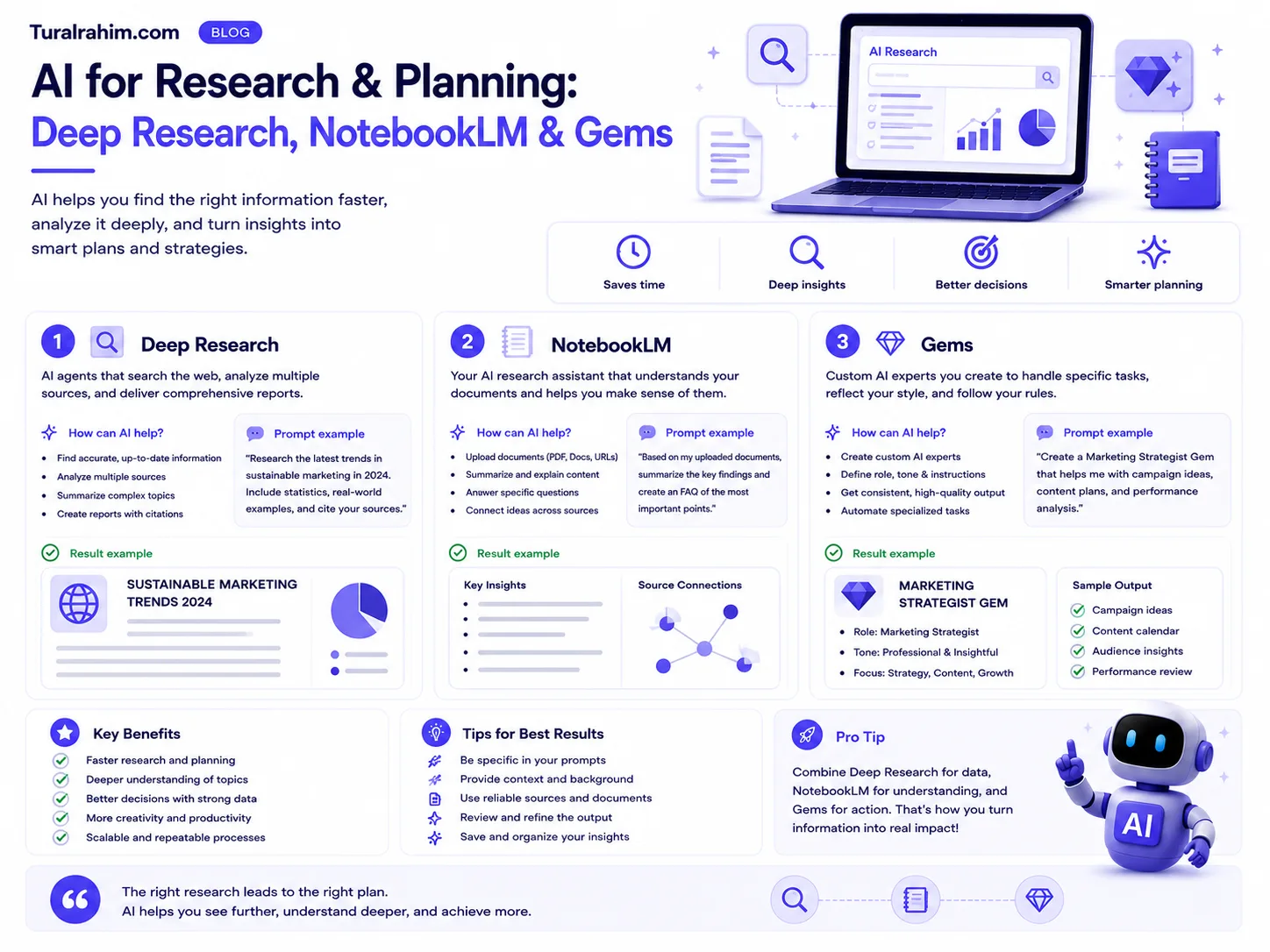
Competitor analysis, market research, project plan — these took days and sometimes weeks before, but with AI digging deep into a topic, reading dozens of sources, and finding the hidden risks in your plan soak up the hours.
This article is the last and most "strategic" part of a ten-word cluster. Not just a texting tool here, but researcher, critic, and planner i'll show you how to operate as one — with three specific capabilities: in-depth research, a knowledge center, and expert assistants.
This post What is Artificial Intelligence (AI)? the final application portion of its guide.
🔬 Deep Research
Ordinary AI answers the question. In-depth investigation but the mode is quite different: you give a subject, AI going to dozens, sometimes hundreds of sites, reads each one, combines the information, and builds a report with the sources.
This usually takes a few minutes-but it takes an entire day of work on your part. Imagine the difference: in ordinary search, you open sites one by one and read them yourself. In an in-depth study, AI does this reading for you and provides a witty summary at the end-you 're reading a report, not a hundred sites.
Why did it work?
Competitor analysis: “Examine the positioning, strengths and weaknesses of the top 5 competitors in the furniture market in Baku.”
Market research “What are the trends in the last 2 years of online furniture sales in Azerbaijan?”
Learning a new field: You're entering a new market and need to understand it from scratch.
Secret: Agree on the plan first
The power of in-depth research is that before it starts, you'll have one investigation plan presents. Most go without reading this plan — and eventually get a report in the direction they don't want.
The right way: read and refine the plan.
“Use only the sources of the last 2 years. Pay special attention to price comparison. Focus on the local market, not the international one.”
That way, the report fits your real need, not the common one.
Golden Rule: In-depth study reads multiple sources, but still able to make mistakes. The difference is that the sources are shown here — check the most important facts with the link to the source. It's more reliable than the usual mode, but it doesn't override the “check” stage.
📚 NotebookLM: Your Own Knowledge Center
In-depth research is looking online. But when you're asked to work with your existing documents — reports, contracts, meeting notes, PDFs?
Where, NotebookLM there are tools like this where you upload your own documents and upload them to your AI based on those documents only standard EN 14350.
Why is it important?
Unlike conventional AI, this type of tool doesn't “fabricate” — because it only speaks to the sources you provide. Plus link to source in each response gives, which means that you can see which ID the sentence is coming from. This severely reduces the risk of hallucination.
Why did it work?
Quick to understand a lot of documentation: You upload 5 different reports and ask, “What do these have in common?”
Team knowledge center: You put together all the project documents and share them with the team. When someone asks, “When does the delivery start?”, they ask you, but not the system.
Launching a new employee: You upload all instructions, rules, and give them to a new employee — they ask you questions, not documents.
Many tools also provide these documents audio overview (such as a podcast), or able to submit as a schematic — for listening on the go, while you're walking.
🧠 Gems: Creating Your Own Expert Assistant
Explaining the same role every time is tedious. Gem (or “special assistant”) is an expert AI you set up once, then run it every time.
For example, you set up an SEO Consultant: you write to him once about his role, his principles, the context of your business. After that, you don't explain every SEO question from scratch-you ask directly.
How to set it up (meta-prompting)
The best method is two-step:
Step 1: “What are the key attributes, principles, and mindset of an experienced SEO professional?”
Step 2: You move this response to the assistant's manual and add, “You're this expert. I'm [my role]. Quiz my ideas, show the weak spots, be honest.”
Tip: if your assistant doesn't respond as you'd like (for example, his tone is too light), adjust the instruction- add context: “I'm a small local business, speak simple and friendly language.”
Some even team of helpers builds: one project manager, one copywriter, one critic. You refer each case to a qualified assistant.
Practical example: a 20-page report in 5 minutes
A real deal. A 20-page market report is on its way, and you'll need to review it tomorrow, but you don't have time to read it.
You upload the document to the knowledge center and go step by step:
“Put the main results of this report on one page.”
"What are the 3 most important numbers and which page are they on?" (you check the source link)
“What's in this report that directly relates to my business?”
Reporting on some tools audio overview you can also convert — in the form of two people talking. You listen to it in the car, idling, or getting ready in the morning. So the excuse that I don't have time to read goes away.
💡 Idea Production & Brainstorming
Here's the under-rated role of AI: you don't have to think alone.
But there's a trap. If you say, “Give me an idea,” you're getting some middle-of-the-road, expected ideas. Mystery asking for range:
“Offer a name for our new service. Give me 3 different tones: one fully logical and professional, one playful and memorable, and one bold and unusual.”
This method gives you a choice — and often the "bold" option works on your own creative mind, even if you don't operate as it should. The idea of AI may not work directly, but it opens a clogged door in your brain. The trickiest part of creativity is the blank page; AI fills that page, and you find your way from there.
Evaluating ideas
It's halfway to getting an idea, and to compare them:
“Set a schedule for each of these ideas: cost (low/medium/high), expected benefit, underlying risk. Then which one do you recommend starting with a limited budget?”
Preparing for 🎯 a Specific Goal
There is a nice but little known application of deep research: preparing for a specific event. Job interview, important meeting, presentation, talk.
Example: getting ready for a job interview. In depth study, you say:
“Prepare me for a briefing about this company [name] and this position [name]. The company's recent activity, its position in the market, what is expected of me in this role, and the typical questions that can be asked — collect them all.”
As a result, you'll have a full view of the company, expected questions, and even initial response projects on hand. Take a few minutes to prepare in a day.
The same logic applies to a customer meeting: you go ahead and research the business, needs, and possible disputes of the party. This always puts you one step ahead at the table.
The 😈 Devil's Advocate: Testing the Plan
This is one of the most valuable methods in the entire cluster, and the least used.
A good plan is a plan that tolerates future problems. But it's hard to see those problems ahead of time — because we fall in love with our own plan. AI here cold-blooded critic plays the role of:
“I've got this plan: [your plan]. Become a devil's advocate. List 5 scenarios where this plan will fail, starting with the most likely one. Deal with me — find the weakest point.”
Why is it so important? Because AI tends to agree with you in nature. If you say, “What's my plan?” they'll say, “Great!” you must make an explicit request — and when you do, you often see the problem that awaits you before you meet.
📋 Finding a Plan Vulnerability
It's one thing to plan, noticing a missing step other. The biggest project challenges are caused by dependencies that are usually ignored.
“You're an experienced project manager. Here's my plan for [my project]: [plan]. Are there dependencies and steps I didn't take into account in this plan? Focus especially on places that depend on other teams or external parties.”
Then focus on the risk:
“Choose the step that carries the most risk and offer a backup plan for it.”
As such, the plan answers not only the question of "what to do," but the question of "what can go wrong and what to do next." That's what separates experienced managers from inexperienced managers-the first ones who see a problem unfold.
Automating Repeated Research
Some studies are not disposable. Competitors price, innovations in your field, market trends regular must watch. Doing this manually every time is exhausting — and forgettable.
In some tools scheduled task set up: You tell AI to repeat some research regularly.
“Repeat this study every week and summarize what's new to me.”
That's how you get a summary of the latest updates in your field every Monday morning — without you having to do anything. This gives you a competitive edge, especially in fast-changing areas (marketing, technology): you know what you need to know, when your competitor is still looking.
One note: this feature is missing all tools and usually available on paid plans. But if there is, it proves its worth in a week.
Combining 🔄 All: The Pathway to a Project
Let's say you're launching a new product. From research to execution, AI is there every step of the way:
1. In-depth investigation — you study the market and competitors.
2. Idea production — get positioning options.
3. Devil's Advocate — try the location you selected.
4. Plan + vulnerability analysis — you set up an execution plan and find the missing one.
5. Knowledge center — you put all the documents together and share them with the team.
Every step of the way, the decision is yours — AI gives you material, views, and criticism, but you press the button. Please note: these five steps at a time would require five different specialists and weeks of work. Now it takes one person, a few days — and that's why AI takes small teams to the same table as big teams.
🤖 Next Step: AI Agents
In everything we've talked about so far, the model worked: you ask, it answers, you take the next step. AI agent but it goes a step further-you give it a goal, it plans and executes the steps on its own.
Make a difference. You tell regular AI, “What do you know about competitors' prices?” she responds. And to the agent, you say, “Go to competitors' sites, collect prices, put them on the schedule, and send them to me every Monday,” which he does step by step.
As strong as this amenity is, it needs serious attention. On your behalf, the agent moving — that when you make a mistake, the result is not only bad text, it is a real step. Here are three rules:
Start small. Give the agent refundable, low-risk jobs first.
Please check your result. Let the agent know what they're doing, and you can verify.
Set a boundary. Be clear about what you can and can't do.
Agents are still in development today, but the overall direction is quite clear: AI from responding do pass. The man who learns the basics today will be ready to welcome this opportunity tomorrow.
⚠️ Responsibility: Testing Again
Research and planning important decisions it's the way to go — so checking here is even more important.
Check the facts from the source. In-depth research leads to the source — at least click on the link to the key facts.
Focus on bias. AI can make one side strong. Ask, "What's the counter argument?"
The final decision is yours. AI lists the risks, but you decide which risk to take — because you will experience the consequences.
❓ Frequently Asked Questions
Is in-depth research free?
Usually fully working on paid plans, limited to free versions. What tool does in comparison i wrote. Gemini is strong in this field.
How much can I rely on researching AI?
Very useful for the overall view and direction. But before you make an important decision, check the basics from the ground up. Here's a simple rule: AI launches research, you approve it.
What is the difference between NotebookLM and regular ChatGPT?
Ordinary AI is all about talk and fiction. NotebookLM only talks about documents uploaded by you and displays a source. So there's an answer to the question, “Where did you tell the fact?” This is more reliable when working with specific documents.
Do you need technical knowledge to build a gem?
No. A gem is just a pre-written instruction-no code, no regular text. It's enough to write, "You're like this, behave like this." Writing a Prompt you can also set up a gem if you know it.
Does it make sense to run these for small businesses?
Especially for a small business. Big companies have separate research, strategy, and planning departments. In a small business, it's often done by one person — and for that person, it's like an entire team.
Where should I start in this amenity?
Don't try to master it all at once-it's the most common mistake. Choose an amenity (deep research for example), try it in your real work for a week, turn it into a habit. Then move on to the next one. Instead of superficial knowledge of the five possibilities, knowing someone better is doubly valuable — because only a skill that becomes a habit becomes a work result.
Is AI research replacing professional analytics?
No serious, high-risk decisions. AI gives you a fast and wide view, but it doesn't replace deep-field experience, a sense of context, or responsibility. The correct model is this: AI does the initial research, and you filter it by your professional judgment. In small decisions alone AI is enough; in big decisions AI + humans are always stronger than AI alone.
Conclusion
We're closing the cluster with this post. An idea was repeated from start to finish, and it is repeated here: AI doesn't replace you, it empowers you.
In research, he reads hundreds of pages on your behalf-but you appreciate the result. In the planning, it lists the risks-but you decide. In the idea, it gives you options-but you choose the option.
It's not a coincidence-the people who benefit most from AI answering machine not like this, thoughtmate it's the ones who work like that, and that's where the difference is: the first one makes you lazy, the second one strengthens you.
Entire cluster in one place
These ten posts complement each other. You can start from anywhere:
Bases What is Artificial Intelligence? · How Does It Work? · Which Tool to Choose?
Prompt Ability: What's Prompt? · Ready Templates · Prompt Chaining
Application: Writing and Communication · Create Content · Data Analysis · Research & Planning (this post)
One more thing — get started. Pick a job this week and give it to AI. Continue, even if the result isn't perfect: you can't learn to play the piano without touching the keyboard. Learning starts with the first touch.

About the author
Tural Rəhimov
Digital Marketing Manager — UM Azerbaijan
Digital marketing manager at Universal McCann (UM Azerbaijan). Experienced in Google Ads, Meta Ads, TikTok Ads and media planning. I help brands grow online.
More about me →Need digital marketing support for your business?
Let's talk — I can help with everything from strategy to ad management.