How Does Artificial Intelligence Work? Machine Learning in Simple Language
17 İyul 2026·👁 11 views
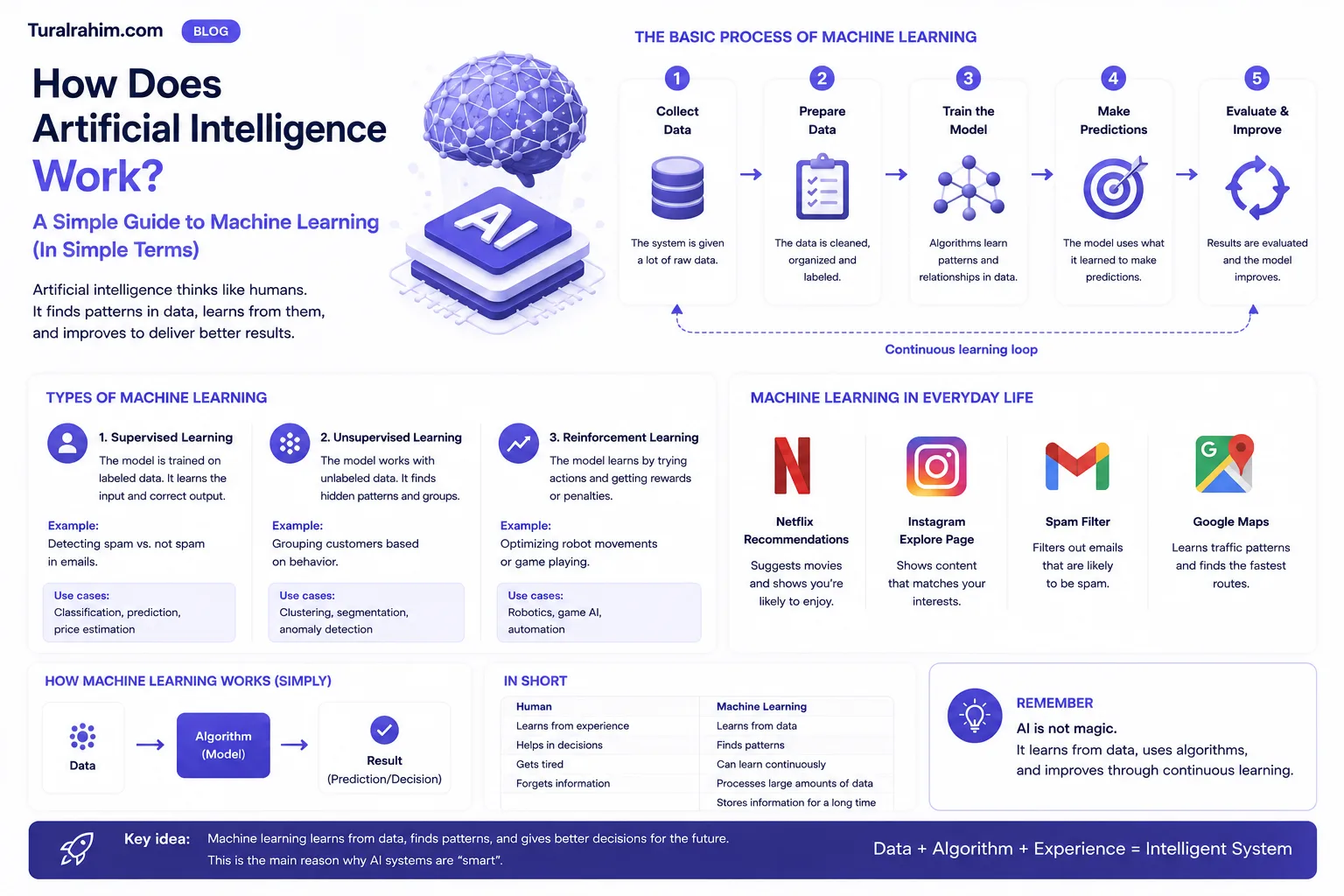
Artificial intelligence works in three steps: first he is shown a giant volume of examples (learning), he finds the repetitive patterns in these patterns, and then when he encounters a new question he has never seen, he relies on the patterns he has learned guesses the answer. He is not taught the rule — he removes the rule from the examples himself. This way of teaching machine learning it's called.
In this article, we'll lift the cap and look inside. Don't worry — there will be no math, no code. But when it's over, you'll know why ChatGPT sometimes looks genius and sometimes a complete fool. And more importantly: here's how to do it to your advantage.
This post What is Artificial Intelligence (AI)? this is a continuation of the guide, and if you don't know the basics, I recommend starting there first.
What is 🧐 Machine Learning?
Let me show you the difference between the usual program and AI in a kitchen.
Ordinary program — Rx. The programmer writes each step in advance: "if the shell is striped, it's watermelon." Whatever is written is done. When the unwritten case is met, the program freezes.
Machine learning — learning by tasting. You don't explain to the child what a watermelon is. You just show watermelon and melons 200 times throughout the summer. There comes a day when a child sees a watermelon he has never seen and says, "watermelon!" Someone didn't teach him the rule — he found the rule himself.
This is what artificial intelligence learns. You give her thousands of watermelon and melon shots. After a while, the pattern of the shell itself, the softness of the shape, the tone of the color set these two apart. You don't tell them these signs — he pulls them out of the dataset.
Learning and output: two different stages
It's important to separate these two words, because most of the misconceptions about AI come from conflating:
Learning (training): Model is built. Long, expensive, and one time it's a process. It takes months, it's worth millions of dollars. You are not participating at this stage.
Outcome (inference): Harnessing what the model is learning. You ask a question, it answers. It takes seconds. That's where you meet AI every time.
A very important conclusion comes from: when you talk to AI, it doesn't learn. Most people think the opposite way. You explain something to her in conversation, she agrees, and she fixes it-but she won't remember anything in a new conversation tomorrow. Because it's not in the learning stage, it's in the output stage.
Golden Rule: See AI as a genius collaborator who comes to work every morning and completely forgets yesterday. No matter how much you explain, context should come from scratch every time. “I said it yesterday” doesn't work.
The 3 Ways of ⚙️ Machine Learning
There are three main ways to teach models. Here's what you need to know so you can guess which job is easy for AI and which is hard.
1. Supervised learning
People dataset in advance tags. That is, each of the thousand pictures reads "watermelon" or "melon". The model sees the question together with the finished answer and learns the connection.
When used: you know ahead of time what the answer will be cases. For example, distinguishing an email as “spam /not spam”.
Example of marketing: You manually mark a thousand customer reviews as “satisfied / dissatisfied.” The model learns and sets itself apart from the remaining 50,000 reviews.
2. Unsupervised learning
No one tags anything. The model is just given the data and it says "what do you see here?" and it self-groups the similar.
Here's the interesting thing: the model doesn't know the word "watermelon," but puts striped ones together and smooth ones together. So he sees the difference, doesn't know his name.
When used: when you don't even know what you're looking for.
Example of marketing: You give your customer base a model, and it finds 4 segments that don't make sense to you-for example, a group like “only buy at a discount.” You didn't know that group existed.
3. Reinforcement learning
The model is trying and making mistakes. When you find the right one prize, mistaken punishment he gets it. After thousands of attempts, he learns how to maximize his reward.
It's like teaching a dog: he did the command right — sweets. This method is what makes chess programs stronger than a world champion.
Models like ChatGPT today a mix of all three ways constructed with. Specifically, the “no response is rude, so it's useful” part is taught by people's assessment — that is, reinforcement.
🤔 What is the Difference Between Generic AI and Ordinary AI?
In the past two years, the phrase "generative AI" has been heard all over the place. The difference is actually quite simple and separated by one question: choosing or creating a model?
Traditional AI — selects and evaluates. You give her a picture of a watermelon, and she selects one from the finished list: "watermelon." He looks at the transaction on your bank card and says "suspicious / normal". The answer is always one of the available options.
Generic AI — creates new content. You say, "Write promotional text about watermelon," and it builds a text that doesn't exist in the world. It doesn't choose — fixing.
ChatGPT, Gemini, Claude, and image-generating tools are all generic AIs. That's because they cause an explosion: formerly AI-only classify he knew, and now he knows create knows.
But there's something subtle here, and most of it goes unnoticed: with the ability to create the ability to be right is not the same. A generic model will always create something-even when you don't know the answer. The root of fabrication (hallucination) is here. For the model, saying “I don't know” is the least natural answer because it's built to create a response.
💬 But how do Texting Models like ChatGPT work?
There is a surprising amount of truth here.
ChatGPT, Gemini, and Claude do not pre-plan the sentence. They guesses only the next word each time. Then he takes the word into account and guesses the next one. And so it goes.
That is, when the model sees "Baku Azerbaijan..." in the background it goes roughly like this:
“capital” — 78% probability
“largest city” — 15% probability
"port" — 4% probability
Then select one of these possibilities. Take care — not always the highest. A little coincidence is added so that the text will come out alive, not like a robot.
Why are two different answers to the same question?
The answer is above: because of that coincidence element. If you ask the same question twice, the model can choose another word a second time, and the answer goes a different way.
It's not a malfunction, it's part of the design. But there's a practical outcome for you: if you got a response you liked, save it immediately. If you say, “Write again,” you won't get the same.
So why is AI wrong in math?
The logic of this should now be clear. The model doesn't calculate the numbers — estimates how the calculation will look. When he sees "247 × 89," he does not address this issue; he looks at what the response to similar issues looks like and writes a convincing number.
Modern models today know this and pass the calculation to the calculator in the background. But the principle remains: The power of AI lies in language, not accurate reporting. Don't assign your financial statement to them.
What Is a 🔤 Token and Why Should You Know?
The model does not read the text wordlessly. Token divides into small pieces called The token is sometimes an entire word, sometimes part of the word, sometimes just a punctuation.
For example, the word "marketing" can be divided into two parts: "market" + "inline" in the eyes of the model. The average word in English text is about 1.3 tokens. In Azerbaijani, that number is higher — because the models are mainly taught in English text, and our pictures divide our words into more pieces.
There are three specific outcomes for you:
Limits are measured in tokens. When the context window says "128,000 tokens," it's not a word but a token. When you type in English, you reach the same limit faster.
Paid plans are account tokened. English text can cost more than English for the same content.
AI can't count letters. The pattern is often misinterpreted when asked, “How many letters' a 'are there in this word?” The reason is simple: he doesn't see letters — he sees tokens. It's not that she's stupid, it's just that she's looking at something else.
🎨 But how does Image and Video Creator AI work?
The text model predicts the next word. And the picture model works in a different logic, which is very interesting.
Imagine: you take a clean picture and add a step by step “snow” (noise) — so that the picture turns into a full gray roar. During the model learning phase playing this process in reverse learns: undoing a picture from a roar.
Then you say to him, "At sunset in Baku, by the sea." Model starts from a random roar and until it matches your words he cleans it step by step, which means he doesn't "take the picture" — he pulls it out of the rooftop.
Here's the practical outcome: the more images you give an image model, the more accurate the result. If you say 'dog', the roar can turn into any dog. The model knows where to go if you say, "After the rain, an old German hunter parked in the park, soft evening light."
The same logic applies to video — in it, the model must regenerate not only the image, but also the movement between shots. That's why creating a video takes more time and resources.
The 🧠 Context Window: AI Short-Sightedness
Have you ever “fooled” AI in long conversations? He forgets what you said earlier, ignores your instructions. This is not a coincidence.
The size of the text that the model can "see" at once is limited. This context window as the conversation goes on, the window fills up and oldest parts fall out. So the AI doesn't forget — it just doesn't see anymore.
A practical solution is three simple habits:
Open a new conversation with each new topic. Do not discuss promotional text, budget, or recruitment in a conversation.
Repeat key terms in the conversation stretch. “I remind you: the tone is a drawing, the length is 3 paragraphs.”
Close conversation when response quality starts to drop and start a new conversation with a concise summary of context.
📉 Drift: Why AI Changes Over Time
Drift — the accuracy and benefit of the model decrease over time. The world is changing, and the model remains where it is. It manifests itself in two forms.
Actual drift
The model was taught with data up to a certain date. The further away we go from that date, the more it becomes out of date.
Here's an example for a marketer: You want a social media strategy from AI. It responds according to the logic of the algorithm a year ago. The platform has changed its rules twice in the meantime. The answer sounds confident — and old.
Behavioral drift
This is a lesser known, but more annoying type. Companies are regularly updating their models. As a result, you type the same prompt, but the tone, format, and length of the response don't come the same as last month.
You don't have the error — the tool has changed under your feet.
How to manage drift
Give yourself some fresh context. Add information about rapidly changing topics (market, technology, law) to the prompt yourself, or use internet access mode.
Be clear about your requirements. No “write well” — “3 paragraphs, formal tone, without marketing terms”. The more accurately you write, the less results drift when the model is updated.
Keep your running prompts. When the result deteriorates, be on hand to revise the prompt and not again.
What Does Knowing 🎯 It Means to You in Practice?
We finished the theory, and all the above compiles into five practical conclusions:
Context is everything. AI doesn't remember yesterday. Write down exactly what you want, every time.
Trust the texture, not the shape. The model speaks the language well, not the world. Check the number, date, name.
Keep what you like. The same answer will never come again.
Keep conversations short and topic-specific. When the context window fills up, the quality drops.
Question quality = answer quality. The model works with probability; if you don't give it direction, it chooses the middle path.
This last paragraph is important to all others and is why I dedicated a separate post: What is Prompt? 3C Rules for Getting the Right Answer from AI.
❓ Frequently Asked Questions
Does AI learn when you're talking to me?
No. The model doesn't change during the conversation-it's already taught. What you say in the conversation is only "visible" within the context window of that conversation. In a new conversation, everything starts from scratch. (Some tools have an “enforcement” function, but it's also a separate recording system, not a model study.)
Is machine learning the same thing as artificial intelligence?
No. Artificial intelligence is the name of the whole field, and machine learning is the most common way to model in that field. the way it is. So every machine learning is AI, but not every AI is built with machine learning.
Why does AI go wrong with simple mathematics, but write complex text in a great way?
Because it's not about calculating, for language it's set up. It doesn't calculate the answer — it predicts what the answer should look like. In text, this works great, and in math, an "approximate right" answer means an incorrect answer.
Can I teach the model my information?
As a regular user, you can't teach the model again. But in practice, you don't have to: uploading or giving context to your document as a file in a conversation often yields the same results. Caution: do not upload sensitive and confidential information to public tools.
What is Generic AI?
It's a type of AI that creates new content — text, image, video, sound. Traditional AI chooses one of the readily available options (“it's spam”), while generic AI builds something that doesn't exist (“write this text”). ChatGPT, Gemini, and Claude are generative models.
How long does AI take to learn?
Large models take months to teach and cost millions of dollars-thousands of powerful processors run parallel month-round. But it doesn't matter: you're using a ready-made model, and the answer to your question comes in seconds.
Why do I get a different answer when I ask the same question twice?
Because the model selects each word with probability, a little coincidence is deliberately added to the selection. This is so that the text can be seen live. If you want a stable result, write the prompt more accurately and explicitly specify the format.
Conclusion
Artificial intelligence is not a magic box. It is based on a pattern learner, who then learns from the pattern estimator it's a system, and all its strength and all its weaknesses are in that one sentence.
The person who understands this is not afraid of AI and doesn't expect magic. It's just working the tool in the right place: in the language, in the idea, in the draft — by trusting; in the number, in the fact, in the final decision — by checking.
The next step is a tool selection. Here's how I compared which one works for you: ChatGPT, Gemini, and Claude: Which AI is Right for Your Business?

About the author
Tural Rəhimov
Digital Marketing Manager — UM Azerbaijan
Digital marketing manager at Universal McCann (UM Azerbaijan). Experienced in Google Ads, Meta Ads, TikTok Ads and media planning. I help brands grow online.
More about me →Need digital marketing support for your business?
Let's talk — I can help with everything from strategy to ad management.