What is Prompt Chaining? Tackling Complex Tasks Step-by-Step
17 İyul 2026·👁 14 views
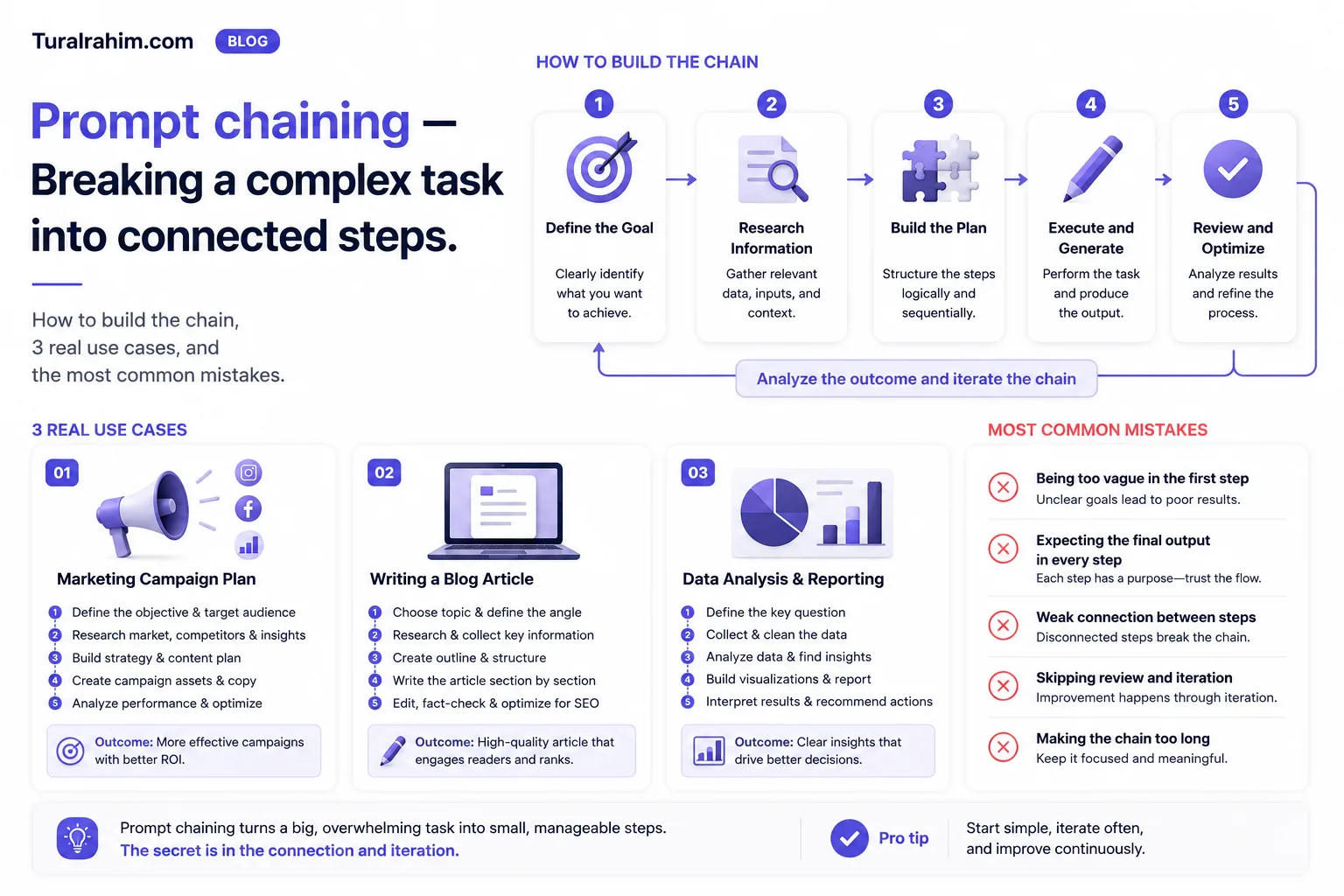
Prompt chaining — a way of breaking a large task into smaller steps connected to each other, rather than solving it with a prompt. The answer to each step becomes the next step entry, and all in the same conversation goes
Imagine this as a conveyor line at the plant: the first loom makes the detail, the second assembles it, and the third paints it. No benchmark does everything all at once — and that's why the result is quality.
In this post, I'll show you how to set up a chain, three real case examples, and the most common mistakes. If you don't know the basics first, start here: What is Prompt? Rule 3C. For a general view: What is Artificial Intelligence (AI)?
🤔 Why Don't You Make A Prompt?
Let's start with a familiar scene.
You write to AI: “Develop a marketing campaign for our new service — identify the target audience, build the message, select channels, split a budget, write a content plan and show us how to measure the outcome.”
The answer is OK. It's long, it's neat, it has titles. But when you read it, you see that each section is a two sentence general word. Audience "People between the ages of 25 and 45". Channels "social media and Google". “Test and optimize” budgeting.
What happened? You put six things together in one sentence. The model also shared the same attention to each one — ultimately made the bottom superfluous.
If you do the same to a person, the result would be the same. If you tell your new employee, “set up a campaign, divide a budget, write content, and build a measurement system today,” you'll have something unfinished to hand in the evening.
Golden Rule: AI attention is limited. The more work you want in a prompt, the less attention goes to each task. The chain concentrates on one spot.
What is 🔗 Prompt Chaining?
Let's start with a simple example-the itinerary.
One prompt: “Write a 3-day itinerary to Georgia.“ The result: a total list that has appeared thousands of times online.
With chain:
1st prompt: “I'm going to Georgia in 3 days. I love history, architecture, and local cuisine, and I don't like crowds. List places worth seeing.”
2nd prompt: “Build a 3-day route that minimizes road time from these places.”
3rd prompt: “Offer local restaurants close to where I'm going, on every day's route.”
Do you notice a difference? In the third prompt, AI already knows what you love, what places to go, and in what order. Each step builds on the previous one.
This is from the AI answering machine to co-worker transforms.
How to Build a 🧭 Chain 4 Principles
1. Start from the end, count backwards
First, tell yourself: what should I have on hand at the end? Ready ad text? Report? Plan?
Then ask backwards: what does it take a step before you get it? What does it take before you can buy it?
Thus the chain itself is formed. Most do the opposite — starting from the beginning, not knowing where he's going, and the chain collapses on the way.
2. Make every step work
The rule is simple: one step = one verb. Sadala. Pick. Set. Write. Criticize, correct.
If you see the “and” in the step (“list”) and choose"), it should probably be split into two.
3. Check every step of the way
The biggest advantage of the chain is: you catch the mistake early.
If you want everything in a prompt, it turns out to be wrong at the end and you have to start all over again. And on the chain, if something went wrong in step 2, that's where you fix it — step 5 doesn't carry the wrong foundation.
That's after each step stop for a second and see the answer. If you didn't like it, don't go to the next step.
4. Stay in the same conversation
Here's the technical reason why the chain works: model context window "sees" the previous steps within. If you open a new conversation, the chain breaks-the AI forgets step 1.
But notice: if the conversation is overheard, the window fills up and the oldest steps fall out. If the chain is longer than 8-10 steps, repeat the intermediate result as a short summary.
📣 Chain Example 1: Ad Campaign
Let's get real now. Let's set up a promotion for a small furniture store in Baku.
Step 1 — Understand: “We have a small shop in Baku that makes furniture on order. Our clients are families who are buying a new home. Our competitors compete on price. What are the customer's top 5 fears in this market?”
Step 2 — Select: “Which of these fears is directly related to our advantage (exact order size)? Choose one and explain why.”
Step 3 — Setting up a message: "Write 3 different main message options on your chosen fear. Have one sentence each. Do not use phrases that all use, such as' quality 'and' affordable price '.”
Step 4 — Text: “I liked option 2, so write Instagram promotional text over it: no more than 2 sentences, a specific challenge at the end.”
Step 5 — Criticism: “Now you're a 38-year-old, tired of renovating, on a budget. Read this text and say: what didn't you believe?”
Step 6 — Edit: “Take these objections into account and rewrite the text.”
Six steps, about 10 minutes. The result doesn't compare to what you'd get from the “prepare a promotion” prompt — because you're on AI thought process you've given.
📊 Chain Example 2: Report to Management
The nature of this chain is that first to AI for whom thinks he wrote:
Step 1: “The 7 most important things from the report I added.”
Step 2: “Set aside these considerations for two people: the director of finance (interested in budget and revenue) and the head of operations (interested in resources and timeframe). Think about the priority of each of them first, then explain which ones they chose.”
Step 3: “Write a brief letter for the finance director — let your chosen points be in the form of items.”
Step 4: “Now you're that finance director. Read this letter and write down the 3 most difficult questions to ask me.”
Step 5: “What should I add to the letter to be prepared for these questions?”
Take care — in step 2, we say, “Think first, choose later.” If this sentence doesn't exist, the AI will give both of them the same points.
💬 Chain Example 3: Decide On Customer Reviews
Step 1: "Divide the following 200 reviews into these categories: price, quality, delivery, service, other. Count how many reviews there are in each category.”
Step 2: “Take the category with the most complaints. Read the reviews there and remove 3 specific issues that are repeated.”
Step 3: “List possible causes for each problem. Which of these can I check with my knowledge?”
Step 4: “Choose an issue that can be resolved quickly and build a 30-day resolution plan.”
What's nice about it? You decide from the dataset — and you can stop every step of the way and say, "Is that right?"
🎭 Meta-prompting: Building a Chain to AI
There is a little known but very powerful method: writing instructions to the AI itself in the first step of the chain. This is called meta-prompting.
The most used form is to create an expert and consists of two steps:
Step 1: “What are the key attributes, mindset, and principles of an experienced SEO professional?”
Step 2: "You're that expert. Features: [Paste the answer to step 1]. I [your role]. Now evaluate [my project].”
Why is this better than just saying, "You're an SEO expert"? Because in the first step, the model opens the content of the role itself — writing what principles he thinks, what he cares about. In the second step, that detailed portrait is in front of him. As a result, the role sits deeper.
You can also apply the same logic to the chain itself:
“I want to get [such a result]. Break this down into steps and write down what I need to ask you every step of the way. Just getting started-let's agree to the plan first.”
AI will give you the chain layout. You'll read it and edit it — “Step 3 is now here, step 2 will take this into consideration” — and then move on to execution. That's how you share the work of planning.
See 🔬 the Power of the Chain Through Your Eyes
Don't believe me — check it out in 15 minutes yourself. This test is simple and convinces the person of the result.
Choose a real job assignment (no fabrication). Next:
In the first conversation — Ask for all in one prompt. Save answer.
In a second conversation (open a new conversation so it's clean) — divide the same thing into 4-5 steps.
Put the two results side-by-side.
What will you look at? Specificity. The first answer will include general “identify target audience” recommendations. The second is specific sentences related to your business, because you've added context every step of the way.
See you in time again. Chain to you more it will take time — about 10 minutes instead of 2 minutes. The question is: how many minutes are you going to spend fixing the result? Usually more than 8 minutes.
⚖️ Chain and Long Prompt: What's the Difference?
It's often stirred, so let's separate it.
Long prompt — you give too much information in one message. It's good: the richer the context, the better. You don't have long context issues.
Chain a lot assignment sequential divide. The problem is not the length, number of jobs required at once.
So the ideal formula is: long context + short task + too many steps.
Sometimes people write "Step 1... Step 2... Step 3..." to a message under the name prompt chaining. It's not a chain-it's just a long prompt, because there are no checks in the slot. Power the chain across stops.
❌ Most Common Mistakes
1. Failure to read interim responses. Frequently go through the steps and look at the end result — it kills the whole meaning of the chain. The error must be caught early.
2. Setting up a very long chain. In a 15-step chain, the context window fills and the AI loses its head. Steps 4-7 are ideal for most jobs.
3. Change the subject in the middle. In the middle of the chain, don't say, "By the way, write me one more thing." Contaminating the chain.
4. Instead of fixing the step, proceed. If the answer to step 2 is poor, don't go to step 3-it will be weak on top of the weak foundation. Go back, fix the prompt.
5. Setting up a chain of every business. The next section is all about that.
🚦 When not to Chainmark?
Let's be honest: you don't need a chain for most of the work.
"Shorten this sentence", "give this word a synonym", "formalize this letter" — these are the only prompts. Dividing them into steps is time-consuming, and it cools you off from AI.
The chain holds true when there are at least two of these three conditions:
On Assignment a few different jobs there (explore + select + write).
Results Important — the customer will go to the manager.
Next Step of the previous one depends.
If you don't have three, just write a good prompt and get going.
🧱 Ready Chain Structures
In practice, most of the work sits on a few typical chains. If you keep these in mind, you won't be thinking from scratch every time.
Chain of Creation
Explore → Select → Build → Critique → Edit
Content, advertising, offer-anything that works for everything you create. This is exactly what the campaign example above looks like.
Chain of Understanding
Summary → Find → deep-seated reasons → Decide
If you have a stack of data, reports, or reviews in front of you — that's it. You're going from general to conversational.
Chain of decision
List options → Compare Call the → devil's advocate → Select
If you're facing an important decision, don't miss the third step. AI has a tendency to agree with you-you must request an appeal yourself.
Chain of preparation
Give the material Read it through the eyes of the → audience Remove → questions Prepare → answers
Presentation, meeting, interview-it's all about the person in front of you. This chain protects you from being caught unprepared.
❓ Frequently Asked Questions
How many steps should the chain have?
Usually 4-7. If it's low, you didn't need a chain. If it's too much, the context window fills up and you have trouble keeping track of yourself. Don't decide the number in advance — list the natural steps of the case, and the count itself will be deducted.
Do I need to rewrite the chain every time?
No — and this is the most valuable piece of advice. Working chain to your template library move. You'll be running the same 6 steps in the next promotion, just changing the details.
Which tool chain is best?
Three it works because the chain doesn't depend on the tool-it's built into the conversation itself. Long chains prefer tools with a wide window of context.
Can AI build the chain itself?
Yes, and it's a good way to get started. Tell him, "I want to get [such a result]. Break this down into steps and write down what I need to ask you every step of the way.“ The AI will give you the chain plan-you 'll get it straightened out and working.
What do I do if I see a bug in the middle of the chain?
Stop and fix it like this: “You misunderstood [it] in this step. The correct option is […]. Please do this step again.“ Then go ahead and let the beauty of the chain come back.
Does the chain give or take time?
The honest answer is: at first glance, it takes time. A prompt is 2 minutes, a six-step chain is 10 minutes. But take the account at the end: how often do you lose a single prompt's response to make it work? Usually half an hour — and most of the time you take it aside and write it yourself. The chain pulls the time to the beginning, and the end gives.
Can I split the chain with my commander?
Yes, and it's the least rated benefit. If you document the working chain and give it to the team, everyone will get the same quality. That's how the chain came up with your personal plan to the working standard of the team turns.
Conclusion
Prompt chaining isn't a technical trick. It's just it's all about moving how you do things to AI.
Think about it: you're not setting up a promotion all at once. First you think, then you choose, then you write, then you show up to someone and get feedback. Here's what the chain looks like — taking your own workflow into steps and sharing it with AI.
That's why the hardest part of learning this skill isn't about AI: you need to know exactly the steps of your work. The person who does this uses AI well, too.
Do something this week: always pick one important thing you do with a prompt and break it down into 4 steps. Compare the result-you won't come back later.
And I'll remind you again: don't apply the chain to everything. Keep things short. Chain is your heavy weapon — keep it to only the things that matter, or you'll get tired and tired quickly.
Now, let's go to the real app: Writing and Communication with AI

About the author
Tural Rəhimov
Digital Marketing Manager — UM Azerbaijan
Digital marketing manager at Universal McCann (UM Azerbaijan). Experienced in Google Ads, Meta Ads, TikTok Ads and media planning. I help brands grow online.
More about me →Need digital marketing support for your business?
Let's talk — I can help with everything from strategy to ad management.