Keyword Research: A Guide to Google Keyword Planner (with Images)
19 İyul 2026·Updated: ·⏱ ≈10 min·👁 107 views

Contents
- Before you research keywords, consider intent and long-tail keywords
- Keyword research with Google Keyword Planner
- Matching keywords to landing pages
- How to interpret the columns
- The second method: check the volume of existing keywords
- Organising keywords into ad groups
- Frequently asked questions (FAQ)
- In summary: strategy, tools and structure
- Your keyword list needs ongoing attention
A successful Google Search campaign starts with choosing the right keywords. But where do you find them? This guide explains keyword research: which keywords to choose, how to use Google Keyword Planner and how to organise keywords into ad groups. We’ll walk through the process with screenshots.
This article is part of the keyword match types is a continuation of the guide.
Before you research keywords, consider intent and long-tail keywords
Before you start researching keywords, consider a few factors. Let’s look at an example: Stella has developed an excellent yoga workout app and wants to reach fitness enthusiasts. Rather than writing down every keyword that comes to mind, she should understand search intent and match keywords to the stages of the customer journey.
This is how the customer journey can inform your keyword strategy. People move from discovering a brand to making a purchase, and they search using different terms at each stage. Match your keywords to those stages and you can reach each customer with the right message at the right time.
People’s intentions vary at different stages of the customer journey. High-intent keywords can indicate that someone is close to choosing or downloading an app, for example, “best yoga workout app” or “download yoga app”. These keywords suit people at the decision stage. Low-intent keywords, such as “yoga poses for beginners” or “yoga benefits”, are used by people looking for general information about yoga. They are often at the awareness or research stage and may not be ready to buy.
Strategy: focus first on high-intent keywords, which reach people near the end of the funnel who are ready to act. This can deliver results sooner and at a lower cost. When it becomes harder to expand your reach with high-intent keywords, or competition pushes costs up, try low-intent keywords too. Stella decides to target people at the earlier and middle stages of the funnel. Instead of asking them to download the app straight away, she invites them to subscribe to a free newsletter, then directs them to the app when they’re ready.
Another way to distinguish keywords is by how broad or specific they are. Broad keywords such as “yoga” and “yoga app” may have high search volumes, but they are often competitive and attract a wide, less targeted audience. Long-tail keywords such as “guided yoga workouts for weight loss” and “yoga app with meditation sessions” are usually more specific and searched less often. They can attract a smaller audience that is a better fit for your offer because they address a more precise need. However, they do not always signal readiness to buy. If your chosen long-tail keywords have a low combined search volume, you can carefully broaden your list.
Keyword research with Google Keyword Planner
Google Keyword Planner is a powerful tool that helps you find keywords relevant to your business and estimate their search volumes. Let’s see how it works. Tim is a digital marketer at Pure Plant Power and wants to advertise one of the company’s best-selling products: 100% plant-based vegan protein powder. To open Keyword Planner, Tim Google Ads signs in to his account and selects “Keyword Planner” from the “Tools” menu.
There are two ways to create a plan in Keyword Planner: “Discover new keywords” and “Get search volume and forecasts”. Tim wants to find new keywords, so he selects “Discover new keywords”. There are two ways to do this: start with keywords or start with a website. To start with keywords, enter terms related to your product. To start with a website, enter your website URL or the URL of a specific landing page, and Google will find keywords relevant to its content. Tim starts with keywords and enters three seed terms: “vegan protein powder”, “plant based protein powder” and “dairy free protein powder”. He also sets the language and location to match his target audience: English and United States.
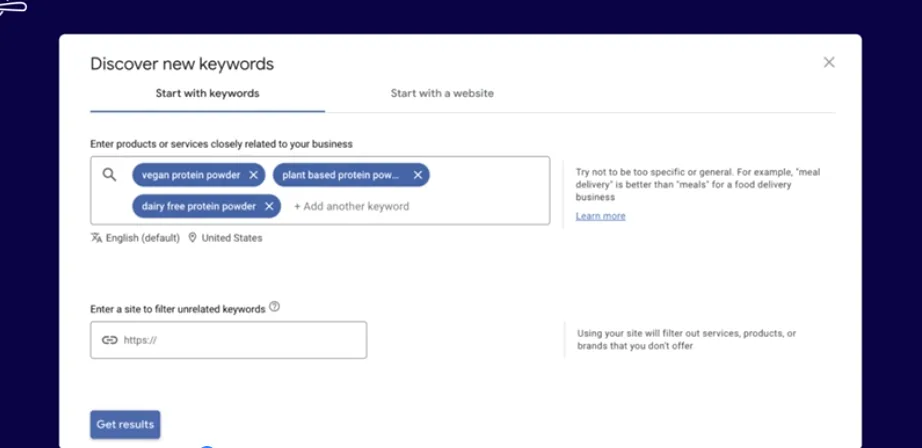
Image: The “Discover new keywords” screen in Google Keyword Planner, showing seed keywords related to the product, language and location settings.
After clicking “Get results”, Tim sees a range of keyword ideas in Keyword Planner. To interpret the results correctly, you need to understand what each column means. The main columns are:
- Keyword: the keyword. Results can be sorted by how closely they match the seed terms.
- Avg. monthly searches: the average monthly number of searches for the keyword and its close variants across the selected period, location and network. You may see a range such as 10K–100K; figures vary depending on your settings and the period.
- Three month change and Year over year change: how search volume has changed over three months and year on year.
- Competition (low/medium/high): the relative number of advertisers showing ads for that keyword in the selected location and network.
- Ad impression share: the impressions your ads received in the previous calendar month as a proportion of all searches that exactly matched the keyword in your targeted location and network.
- Top of page bid (low/high range): the lower and upper ranges of historical bids that resulted in an ad appearing at the top of the page. This is not the actual cost per click.
- Account status: whether the keyword is in your account and its status in the campaign it belongs to.
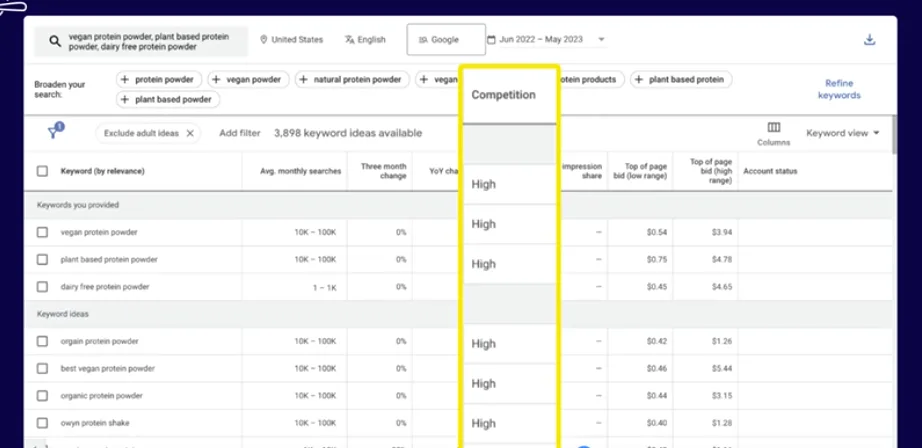
Image: The Keyword Planner results table, with columns for keyword ideas, monthly search volume, competition and the top of page bid range.
You may also see many competitors’ brand names in the results. It may be better to avoid bidding on these brands at first, as clicks can be expensive and your ads may perform poorly with people searching for another brand’s products. Use “Refine keywords” to filter out brand and retailer names. Then select relevant keywords using the checkboxes, click “Copy” and transfer them to a spreadsheet application such as Google Sheets, Excel or Numbers. These keywords will form the basis of your ad groups.
Matching keywords to landing pages
One aspect of keyword research that is often overlooked is how well keywords match landing pages. Each keyword you find should lead customers to a page that meets their needs. For example, Tim should send someone who clicks an ad after searching for “vegan protein powder” directly to the product page for the vegan protein powder, rather than the home page. When the need expressed by the keyword matches the landing page content, the likelihood of a conversion increases. A relevant and useful page can also improve ad quality. Some aspects of this quality are reflected in Quality Score, but the score itself does not determine cost or position.
So, when researching keywords, ask not only “Which terms will I target?” but also “Which page will I send someone who searches for this term to?” Sometimes you may find that your existing pages aren’t enough and you need to create a new landing page. This alignment between the keyword, ad copy and landing page is the foundation of a successful Search campaign.
How to interpret the columns
Keyword Planner provides a lot of data, but the real skill lies in interpreting it correctly. When choosing keywords, pay particular attention to three columns: search volume, competition and bid range. High search volume means greater traffic potential, but when competition is also high, clicks can be expensive. Keywords with low volume and low competition may bring less traffic, but can be cheaper and more targeted. You can find examples like these among long-tail keywords.
In practice, don’t focus only on the keywords with the highest search volumes. A keyword with a medium search volume, low competition and strong intent can sometimes deliver better ROI than a high-volume, highly competitive keyword. The bid range (top of page bid) gives you an idea of historical bids. If your budget is limited, use this information to test more affordable alternatives. The Competition column shows the relative number of advertisers. When competition is high, the quality of your ad and landing page is especially important for standing out.
The second method: check the volume of existing keywords
Keyword Planner can help you assess an existing list as well as find new keywords: select “Get search volume and forecasts”. If you already have a keyword list, perhaps one you collected earlier or found while researching competitors, enter it to see search volume, competition and forecast results for your plan. This helps you assess your current list and decide which keywords are worth allocating budget to. Keyword Planner can therefore help you both find new keywords and assess existing ones.
Organising keywords into ad groups
As we know, every Search campaign contains ad groups: sets of ads and keywords organised by theme or product category. Grouping keywords into ad groups is a key step in building an effective campaign structure. It has three benefits:
- Tailor ad copy and landing pages to a specific topic: give users an experience that better meets their needs.
- Improve how well the ad and landing page match: this can also be reflected in the relevance components of Quality Score.
- Manage and optimise the campaign in more detail: analyse results at ad group level.
There are three steps to organising keywords into ad groups. First, review your keywords and understand their search intent and context. Identify keywords that share a theme; some may fit more than one. Second, define your main themes and categories. In Tim’s example, there are three: vegan, plant-based and dairy-free protein powder. Although the terms are similar, people may search for them for different reasons: someone may avoid dairy because of an allergy, someone else may eat only plant-based foods, while another person may be vegan for environmental reasons. Third, place keywords in the relevant ad groups. Start with the first theme, vegan protein powder, select the relevant keywords and add them to an ad group called “vegan protein powder”. Then repeat the process for the other two themes.
You may need to revisit earlier steps as you work. Some keywords may not fit any theme, while others may need further research before you can group them. Then copy the keywords into Google Ads and choose a match type. Tim puts quotation marks around all his keywords to use phrase match. This can help balance reach and relevance.
Frequently asked questions (FAQ)
What is Google Keyword Planner?
A free Google tool that provides relevant keyword ideas and search volume estimates. Open it from Tools > Keyword Planner in your Google Ads account. You’ll need to complete your account setup with billing information to access it.
What are high-intent and low-intent keywords?
High-intent keywords are searches made by people close to taking action, such as “download yoga app”. Low-intent keywords are general research searches, such as “yoga benefits”. Focus on high-intent keywords first.
What is a long-tail keyword?
Long-tail keywords are usually more specific and searched less often, such as “yoga app with meditation sessions”. They can attract an audience that is a good fit for your offer, but not every long-tail search signals intent to buy.
Why organise keywords into ad groups?
To tailor ad copy to a topic, improve the match between your ad and landing page, and manage your campaign in more detail.
Can you bid on competitors’ brands?
Yes, but proceed with caution at first: clicks can be expensive, and your ads may perform poorly with people searching for another brand’s products. You can filter out brand names using “Refine keywords”.
What is Quality Score?
A diagnostic score from 1 to 10 that compares ad quality at keyword level. It is based on expected CTR, ad relevance and landing page experience; the score itself is not used in the ad auction.
Should I choose broad or long-tail keywords?
Use both together. Broad keywords can provide wider reach, while long-tail keywords can reach a narrower audience with a more specific need. Long-tail keywords are often more cost-effective to start with.
What should I do before researching keywords?
Consider intent and the balance between broad and long-tail keywords. Match your keywords to the stages of the customer journey.
In summary: strategy, tools and structure
Keyword research brings together three elements: strategy (intent and a long-tail approach), tools (search data from Google Keyword Planner) and structure (organising keywords into ad groups). When all three work together, your campaign can reach the right people and make efficient use of your budget. As in the example of Stella’s yoga app, start with specific, high-intent keywords, then expand your list.
Practical tip: open Keyword Planner today and enter a few seed keywords for your business, or one you’ve chosen to practise with. Review the results for search volume, competition and bid range. Then organise the keywords you find into two or three themes. This simple exercise will help you put the principles of keyword research into practice. Remember, keyword research is an ongoing process, not a one-off task.
Your keyword list needs ongoing attention
One important point: building an effective keyword list isn’t a one-off task. Like Tim, advertisers need to monitor and optimise their keyword lists continuously to improve campaign performance. Analyse how much traffic and how many conversions your keywords generate, and what those results cost. Over time, you can identify the keywords that perform well and allocate more budget to them, while reviewing or pausing those that perform poorly.
This ongoing cycle of measuring, learning and adjusting is at the heart of keyword strategy. As markets, competition and user behaviour change, a keyword list that worked perfectly yesterday may need updating today. Treat keyword research as an ongoing process, not a one-off task.
Next: managing keywords becomes more difficult on large websites with many products. Dynamic Search Ads How does it solve this problem?
Topic: Google Ads: posts in this topic →

About the author
Tural Rəhimov
Digital Marketing Manager: UM Azerbaijan
Digital marketing manager at Universal McCann (UM Azerbaijan). Experienced in Google Ads, Meta Ads, TikTok Ads and media planning. I help brands grow online.
More about me →Need digital marketing support for your business?
Let's talk: I can help with everything from strategy to ad management.